
Our Complaint of a Negligent God
The reason many people who don’t believe in God give for their unbelief is that the presence of evil seen today seems incompatible with the existence of an all knowing, all powerful, all good god.
Surely we imagine, if such a god existed the world would be a better place. Certainly a good and powerful god would stop children from being abused, and wars from destroying, and poverty from ravaging. Such an god we imagine would step in like Iron Man or Spiderman to stop the bad guys and rescue the innocent. If we can imagine fallible superheroes getting the job done, certainly we can imagine a god backed by mighty angels to make some measurable improvement.
The Iron Man argument is interesting. Let’s imagine Iron Man bursting into a home where a father is beating his child. Let’s imagine Iron Man stops the assault. What then? Every police officer and social worker knows that stopping an incident is probably the easiest part of addressing an enormously complicated situation. Do you take the child out of the home? Where do you then place the child? Is the foster home better? How do you know? What happens when the child turns 18?
Mercenary Morality
Civil governments have long learned that a combinations of carrots and sticks can improve human behavior. If you drive irresponsibly you may get a ticket. If you damage someone’s property your property may be taken as compensation. If you harm or kill someone sever consequences to your freedom or life may be exacted by the law. We want to create an environment where good behavior is rewarded and poor behavior discouraged and punished. Through this mechanism we predictably improve our common life together. This is not rocket science.
We do also realize, however, that despite the important improvements this system yields for society such a system is insufficient to make people truly good. How do we know this? Take the system away and watch how quickly things devolve.
We also commonly appreciate the fact that moral compliance premised upon the intrusive watchfulness of a benevolent overlord is of less value than goodness and generosity freely extended.
Recently a panhandler returned a diamond ring and the grateful owner has launched an effort to collect money for the man. So far they’ve gotten over $86k. The reason we so respect his returning the ring is because there was no expectation of this kind of reward. If there had been an expectation of this kind of reward, we would view the incident in a very different light.
We should also note that no matter how much money they raise, my guess is that the deeper issues beneath the homelessness will likely NOT be resolved by money. If there is a mental health or substance abuse issue, more money and more power may fuel self-destruction and be dangerous to others.
This dynamic was not lost on the writers of the Bible. The book of Job begins over this very issue.
Job 1:8–11 (NET)
8 So the Lord said to Satan, “Have you considered my servant Job? There is no one like him on the earth, a pure and upright man, one who fears God and turns away from evil.” 9 Then Satan answered the Lord, “Is it for nothing that Job fears God?10 Have you not made a hedge around him and his household and all that he has on every side? You have blessed the work of his hands, and his livestock have increased in the land. 11 But extend your hand and strike everything he has, and he will no doubt curse you to your face!”
A New Approach with Abraham
One way to view the story of Noah’s flood is through this lens of morality. The LORD chooses the most moral, most upright man in all the earth and decides to rebuild the human population through him and his family. Obey God and be blessed. Disobey God and be punished. It didn’t work with Noah.
What God initiates with Abraham is a different approach. God does NOT pick the most moral man in all of the world. There is nothing in the text indicating that God has selected Abraham on the basis of his morality. In last week’s story, in fact, we saw two stories of Abraham being morally weak.
The contrast between Noah and Abraham is dramatic. We all know that it is easier to kill an immoral man than it is to make him moral. This is doubly difficult when we reflect on the fact that most of our morality improvement programs really only address behavioral compliance not the kind of free generosity we value and want to see manifest in our world.
The LORD begins a project with Abraham to not just make the world a better place, but rather to transform it, not by a program of forced moral behavioral compliance, but with free generosity. Abraham is not just a test case, but intended to be the seed through which a movement will sweep through human history. This is a truly audacious plan.
Abraham and Lot
The complexities of life often require that we learn through comparison. The Abraham story in the Bible is a long one told through a series of well structured stories that invite us to make comparisons between characters. Last week we compared called Abraham to his moral superior King Abimelech. This week we’re invited to compare Abraham and his nephew Lot.
There isn’t anything directly in the text about it, but I would imagine that Lot was Abraham’s first “plan B” when it came to addressing his greatest existential threat, his inability to produce offspring.
Abram (Abraham’s old name) leaves Haran with Sarai (Sarah’s old name) AND Lot in tow. Lot was fatherless, and Abram was sonless. A perfect match. Surely, as Abram might imagine, Lot could be understood to be a reasonable interpretation of the LORD’s promise to make Abram into a great nation. Lot apparently was capable of fathering daughters, could a male heir be far behind?
An Awkward and Consequential Fork in the Road
In a world where God’s favor was divined through material abundance Lot would have been called “blessed”.
The text is then struck with an odd case of affluenzia. Abram and Lot’s flocks are too great for the land and their shepherds are in conflict. The Hebrew text is often subtle and implicit. What was the subtext beneath this story? Did Abram and Lot have a falling out? Robert Alter notes the polite but blunt phrasing of Abraham’s second word. “Kindly part from me.”
Although Abraham initiates the separation, he is here (in contrast to the last story where he gives his wife to Pharaoh to save his own skin) magnanimous towards his nephew. Culturally no one would have questioned Abram’s right to the greater share, but now he invites Lot to chose a place to support his affluence and Abram will settle for second best. What we witness here is Abram’s first act of public godliness. He is practicing with his nephew “your wellbeing at my expense”.
Lot, rather than emulating Abram’s generosity, sees his opportunity and grabs it. In a scene that reminds us of Satan’s trip with Jesus to “Inspiration Point” Lot surveys the whole land and chooses the best he can see. The author Genesis compares to both to the Garden of Eden (the garden of the LORD) and Egypt. It is an interesting comparison.
So Lot and Abram separate. Lot takes what looks like the valley of “the way things were mean’t to be” but as we’ll see also looks something like empire Egypt, what will become the land of bondage. The author of Genesis quietly notes the moral quality of the people with whom he will share this bounty.
What Empire Wants and Requires
No sooner have they parted ways (at least in the telling of the story) than Lot is in need of rescuing. Apparently Lot is not alone in surveying the abundance of the Jordan Valley. A contingent of kings from the city states of the Fertile Crescent have similarly set their hearts on the bounty of that land and decided to march their armies down to make it their own. Part of the prize is of course the people, slaves for fields and farms. Perhaps the valley would indeed become like an Egypt to Lot, a house of bondage.
Abraham, cast in his only role as military leader, upon hearing of Lot’s fall into slavery mounts a rescue operation.
Abraham not only rescues Lot, but also the other people and plunder taken from the cities of the plain.
Abraham in this story too is a man who knows he has been blessed by another. He tithes “God Most High” through the king/priest of Salem (Jerusalem?) but rebuffs the invitation of the King of Sodom lest he be put into his debt.
We are being given early signs that Lot may be in trouble, and that Abram’s generosity which on its face looks unwise, may perhaps be very wise indeed.
The LORD, Abraham and Sodom
Lot will seemingly drop from the story until three visitors comes to Abraham. Here Abraham earns his reputation as a model of hospitality. He offers “a little water” and “a piece of bread” and then rushes to prepare a banquet for the strangers.
In the interest of time we’ll skip over for now the discussion of Isaac’s birth and jump to the dialogue over Sodom.
Genesis 18:16–20 (NET)
16 When the men got up to leave, they looked out over Sodom. (Now Abraham was walking with them to see them on their way.)17 Then the Lord said, “Should I hide from Abraham what I am about to do?18 After all, Abraham will surely become a great and powerful nation, and all the nations on the earth will pronounce blessings on one another using his name. 19 I have chosen him so that he may command his children and his household after him to keep the way of the Lord by doing what is right and just. Then the Lord will give to Abraham what he promised him.” 20 So the Lord said, “The outcry against Sodom and Gomorrah is so great and their sin so blatant.
This is a remarkable passage on so many levels. Robert Alter notes that this is the first mention of moral outcomes as a result of God’s election of Abraham and this mention is connected with God’s obvious desire to include Abraham in the conversation of what to do with the wicked, in this case the cities of the plain where Lot has settled.
Walter Brueggemann notes that what we have here is a break from common religion. The carrot and stick approach to morality is common religion, assumed nearly universally in human society. It is God’s job to keep order by judging the evil doers and protecting the innocent. This is the basis for our complaint of a negligent god. Brueggemann notes that in this conversation, common religion is critiqued, and humanity through Abraham is invited into the conversation.
Yhwh Stands Before Abraham
Your Bible probably says
Genesis 18:22 (NET)
22 The two men turned and headed toward Sodom, but Abraham was still standing before the Lord.
If you read a good commentary you may find out that there is good reason to assume that the original text had it reversed, that the LORD stood before Abraham. Many scholars believe the text was changed because it seemed impious to imagine that the LORD would allow himself to be judged by Abraham, rather than the assumed, proper situation where Abraham is judged by the LORD.
As the conversation unfolds, we’ll see Abraham as the epitome of measured, respectful, bold, intimate relationship with the LORD, but the position he takes is to challenge the LORD’s intention of destroying the cities, for the sake of the innocent.
Tim Keller in his sermon on this passage notes that a new idea is being offered here. We common assume that it when some are wicked the whole society suffers for it. Japanese society in World War II suffered horribly from the bombs of the American Air Force because of the decisions of their leaders. Abraham opens up a new front. Might it be possible that the wicked be spared for the sake of a few righteous?
To our amazement, the LORD is open to our influence. When marriage counselors are working with a couple in order to repair trust and the relationship one thing they commonly look for is the question as to whether each partner is open to be influenced by the other. Here, the LORD opens himself up to be influenced by Abraham. This is the foundation of prayer.
Lot Fails Where Abraham Succeeded
Abraham haggles with the LORD as far as Abraham has courage, but Abraham’s courage can’t reach Lot. Abraham, who will later show his bias against Abimelech, hopes that there are more righteous in Sodom than he ought. For ten righteous the city will be spared, but ten righteous will not be found.
The two “men” who continued to Sodom indeed found the city subject to judgment and proceeded to attempt to rescue Lot.
The story is intentionally told to parallel Abraham and Lot as shown by Gordon Wenham. (if the image below doesn’t appear right, click on it and it should be OK.)
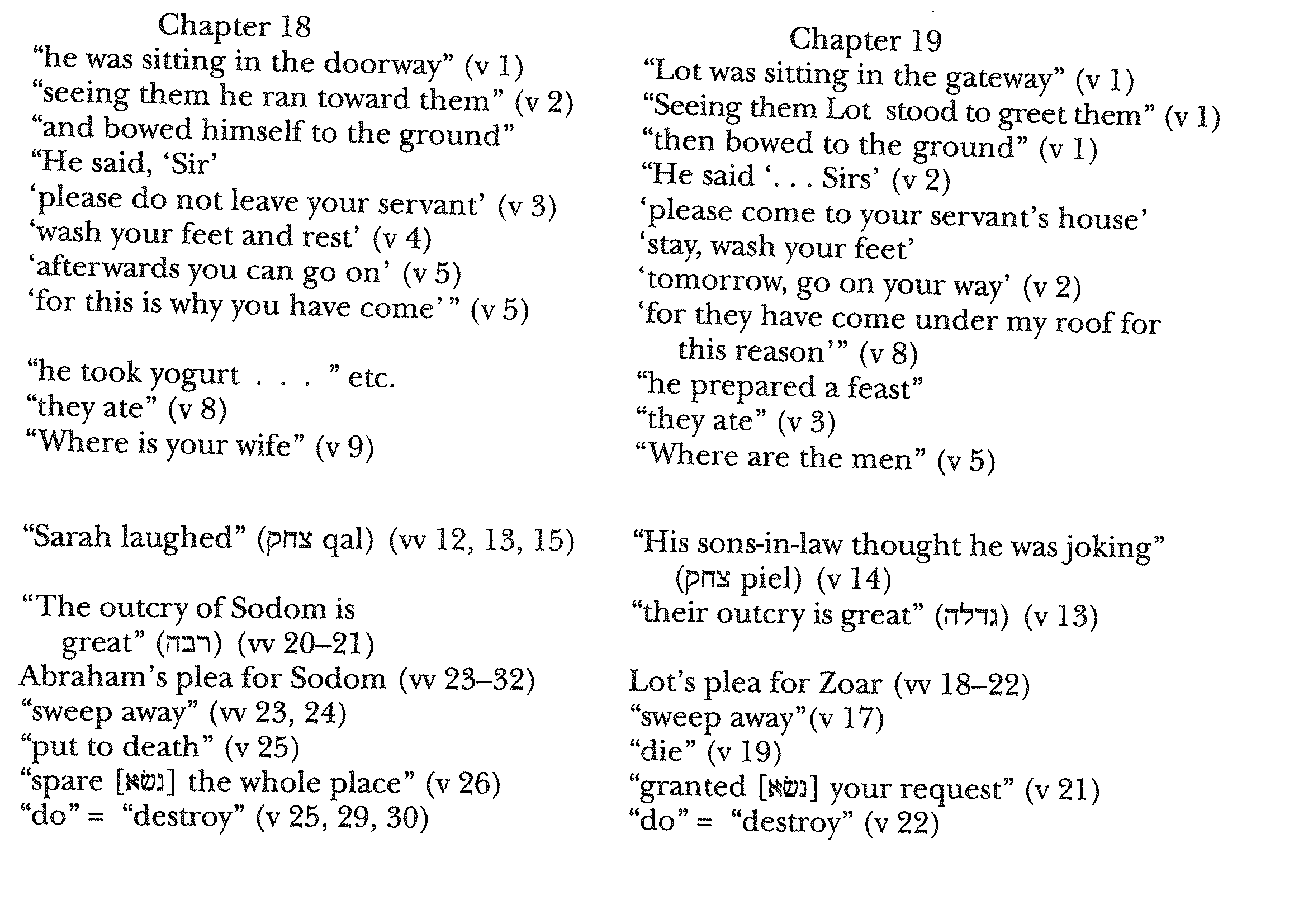
While Abraham may have assumed Lot might be an heir of the LORD’s promise, and while Lot will himself be the father of nations, Lot is the victim of his own choices. His suggestions are full of folly, suggesting his daughters satisfy the men of the town who clearly wish to own the visitors, rather than showing them hospitality. Like Abraham he attempts to protect his own position at the expense of the female members of his household. He does not offer his own body assuage the assault.
He is impotent to protect the strangers who come to the town. He cannot hold back the evil of the town and he cannot shelter his own family from it. Even after Lot, his wife, and two remaining daughters are escorted out of the city his wife falls victim to her longing to stay. His daughters later in a mountain cave bear witness to their own assumption of the way of the world “my wellbeing at your expense” by echoing the story of Noah where the drunken father is violated by his children.
The Lot and Abraham story began on a mountain looking over the land and Lot choosing Sodom. The story concludes with Abraham returning to the place he met with the LORD only to see the smoke of destruction rising up from the destroyed cities of the plane.
Three Thoughts
1. God’s calling is not something we have control over. God’s election is something we’re invited into.
Throughout the Abraham story Abraham will be at times found to be an amazing example of faith, and at times an amazing failure. Abraham is like us. He’s not so much a hero, at least not while he’s living. He’s taken God up on the opportunity to participate in God’s mission. He is invited into the kinds of conversations we can’t imagine. The judge of heaven and earth takes him into his council, accepts his influence, and even concedes points to him. Given the dramatically high view of God the Bible holds, this is an astonishing development.
2. The electing relationship changes Abraham.
Contagious Christian materials produced by Willow Creek church had a formula: High Potency + Close Proximity + Clear Communication = Maximum Impact. The LORD seems to practice this with Abraham.
Abraham’s place in the relationship is clear to Abraham. Clearer to him given his cultural background and close proximity to the power of the LORD. Abraham knows that every time he meets with God. Annie Dillard reminds us of this with her great quote.
Why do people in church seem like cheerful, brainless tourists on a packaged tour of the Absolute? … Does anyone have the foggiest idea what sort of power we blithely invoke? Or, as I suspect, does no one believe a word of it? The churches are children playing on the floor with their chemistry sets, mixing up a batch of TNT to kill a Sunday morning. It is madness to wear ladies’ straw hats and velvet hats to church; we should all be wearing crash helmets. Ushers should issue life preservers and signal flares; they should lash us to our pews. For the sleeping god may wake someday and take offense, or the waking god may draw us to where we can never return.”
—Annie Dillard, Teaching a Stone to Talk: Expeditions and Encounters (New York: Harper & Row, 1982), pp. 40-41.
Abraham is already there. It is in fact, in this place where God does his important work through him. Why Abraham and not Lot? We cannot answer the mystery of election.
3. Abraham is drawn into the council of God, an advocate for miserable, rebellious humanity.
In Abraham, in Genesis 18, we have for the first time an advocate for our broken race. We have one that makes a plea for mercy for those who don’t deserve it. We have one to whom the Almighty has opened Himself up to his influence, and is considering amendments to assumed common religion. We have one who is, politely, respectfully, suggesting that losing us all is not what our Maker truly wants. Abraham is a prototype of the kind of savior we need. This advocate asks that God of course not be negligent, but that he also not be tyrannical.
The Back to the Future of Election
Christian theology suggests that Abraham’s election is a subset of Christ’s. This of course doesn’t fit well with our historical timeline, but then again Jesus is reported to have said “before Abraham was, I am.”
What we see in Abraham is the first taste of what we see in Christ, and what we receive as followers.
When God invites us into his counsel, makes himself subject to our influence, hears our petitions, we begin to grow up into him. When we do so, we begin to do as Abraham did in part, and Christ did in full, begin living responsibly within the relational polarity of “your wellbeing at my expense.”
This included letting Lot travel to Sodom. It included rescuing Lot, receiving the praise of one king and declining the invitation of another. Through this relationship, initiated by election, affirmed by obedience, even uneven, sporadic obedience, together with Abraham progress on a path of transformation that rescues history.
To reach back to an earlier story, Adam and Eve opted for the fruit in order to become like God. What God is doing in his movement towards Abraham, in his calling of Abraham, is helping Abraham, and us, fulfill Adam and Eve’s wish. In this way the fertile plain that Lot opts for may become the Garden of the LORD, rather than the prosperous slave fields of Egypt.


 Leadingchurch.com