
Being without Story
Nearly every ancient civilization had creation stories. These stories weren’t usually so interested in where the “stuff” around us came from, they were usually more interested in “what is it for”.
The creation story of the Hebrews found in their Scriptures in Genesis chapter one says that this world is good and it was made for its makers enjoyment and glory.
We moderns live in a strange time where we have an account of the material origins of the universe without a story about what it is for. The implicit message of this universe absent a story to give it meaning is that we can give it anyone we choose. We can decide what life is for or what the universe is for because we are the only creatures with a large enough brain to be able to create stories. We make meaning.
When peoples with creation stories engage people without them many atheists will declare that they also have see morality, meaning and wonder. The problem with all of those people who have stories rooting in their religions or ethnic ancestry is that they are too rigid and these stories become grounds for fighting.

The atheists and non-religious have a point. Religious people do fight all the time. Throughout the course of human history people have justified the privilege of their groups on the basis of these stories. Anthropologists have noted this.
In the language of the Dinka people of the Sudan, ‘Dinka’ simply means ‘people’. People who are not Dinka are not people. The Dinka’s bitter enemies are the Nuer. What does the word Nuer mean in Nuer language? It means ‘original people’. Thousands of miles from the Sudan deserts, in the frozen ice-lands of Alaska and north-eastern Siberia, live the Yupiks. What does Yupik mean in Yupik language? It means ‘real people’.
Harari, Yuval Noah (2015-02-10). Sapiens: A Brief History of Humankind (Kindle Locations 3042-3045). HarperCollins. Kindle Edition.
Look at the history of the Hebrews. By the time of the New Testament you had Jews and “Gentiles” which basically meant everyone but them. You had “Greeks” and “barbarians” or “Romans” and “barbarians”. Christianity struck a blow against this by creating a new class of people: “Christians” who could be Jew, Greek, Roman or barbarian.
This led, however, to “Christian” and “non-Christian” which could start the feuding all over again. Into this Western secular liberalism says “we are all people, homo-sapiens. Can’t we all get along?”
At each turn, when it seems that division itself has been transcended we seem to find new ways to divide. We implicitly divide people into “good people” and “bad people” or “people with the right ideas” and “people with wrong ideas, bias or prejudices”, and around we go with more arguing and fighting.
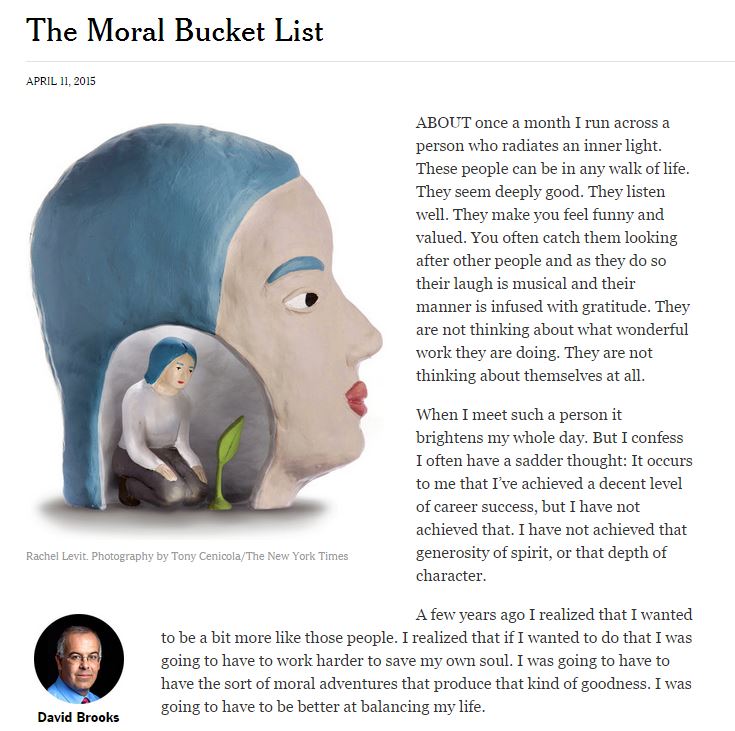
David Brook’s Moral Bucket List
The vision is to construct a moral vision that anyone can agree upon and that can embrace everyone. This is not a new project, many civilizations, the Greeks, the Hindus, the Chinese, and European enlightenment have been working on this. Sometimes its called “natural law”. Sometimes just “right and wrong”. It is an attempt to construct a universal vision of “the good” without all of the divisions origin stories. CS Lewis in his appendix to The Abolition of Man has an interesting section showing the great similarities between many of these systems.
There is so much similarity that it so often inspires hope in this project. I see many people embracing this hope. You hear it when people decide to hide or strip their language of religious particularity and camp out on generic words apart from religious stories or religious names. Who can argue with these words
- Love
- Grace
- Truth
- Justice
- Hope
- Faith
- Kindness
I love reading David Brooks. He recently wrote a piece called “The Moral Bucket List”. I think a lot of this is part of a book he’s writing that I’ll want to read. His writing is uncommonly rich in insight into public morality and civility. I almost always read him with profit and this piece was no exception.
ABOUT once a month I run across a person who radiates an inner light. These people can be in any walk of life. They seem deeply good. They listen well. They make you feel funny and valued. You often catch them looking after other people and as they do so their laugh is musical and their manner is infused with gratitude. They are not thinking about what wonderful work they are doing. They are not thinking about themselves at all.
When I meet such a person it brightens my whole day. But I confess I often have a sadder thought: It occurs to me that I’ve achieved a decent level of career success, but I have not achieved that. I have not achieved that generosity of spirit, or that depth of character.
A few years ago I realized that I wanted to be a bit more like those people. I realized that if I wanted to do that I was going to have to work harder to save my own soul. I was going to have to have the sort of moral adventures that produce that kind of goodness. I was going to have to be better at balancing my life.
What David Brooks offers here is something similar to the dream of having a universal shared morality without the particularities of an origin story or religious particularism. It doesn’t matter your gender, your ethnicity, your orientation, your background, you can achieve in this meritocracy of virtue. If you try hard enough, are sacrificial enough, you can become a better person, a spiritual person, a helpful person, maybe even a great person!
The Repeated Failure of this Dream
As beautiful as this dream is and as often as it is repeated it would be unfair to notice that it has failed every time to achieve what it seeks to do. It seeks to unite humanity, make us all good, civil, loving, giving, and wise. It seeks to recreate civilization into a safe, nurturing loving place where all can share equally in its fruits.
Part of the reason it fails each time is that among the diversity of the projects they can’t agree on particularities. They may all agree that “love is good” but they can’t all agree on what love looks like. They can all agree that “truth” is good but they can’t all agree on what truth is or how love and truth are expressed in every and all situations.
David Brooks tries to appeal to the moral vision of today, but the particulars of today’s moral vision were not identical with that vision that an urbane New Yorker held 50 years ago, never mind someone who lives in a radically different time and space. Given what we know about the speed of change an urbane New Yorker 50 years from now will likely look back at David Brooks and see his short comings. Trying to erase particulars by using generic words always falls short when it comes down to every day life which is not “universal” but practical, contextual and local. Pick a topic and you can find this knotty little fact.
We need a Way
The failure of this generic way is best illustrated by the fact that we keep being presented with attempts to do it again. I often quip that if you go to the bookstore and look in the self-help section you should have some healthy skepticism. If any one of this books “worked” for everyone there would only be on book there. That isn’t to say that you can’t find wisdom and good advice in some or even many of them, it is to say that even though we look at a project like David Brooks’ project with some admiration we should also probably set it along side all of the other religious projects as something that may be able to offer wisdom, insight, and might in fact do us all some good, but it is not a replacement for everything else nor a universal program to transcend them.
John 10
In John 10 Jesus says some pretty alarming things.
John 10:1–10 (NET)
1 “I tell you the solemn truth, the one who does not enter the sheepfold by the door, but climbs in some other way, is a thief and a robber. 2 The one who enters by the door is the shepherd of the sheep. 3 The doorkeeper opens the door for him, and the sheep hear his voice. He calls his own sheep by name and leads them out.4 When he has brought all his own sheep out, he goes ahead of them, and the sheep follow him because they recognize his voice. 5 They will never follow a stranger, but will run away from him, because they do not recognize the stranger’s voice.”6 Jesus told them this parable, but they did not understand what he was saying to them. 7 So Jesus said to them again, “I tell you the solemn truth, I am the door for the sheep.8 All who came before me were thieves and robbers, but the sheep did not listen to them.9 I am the door. If anyone enters through me, he will be saved, and will come in and go out, and find pasture.10 The thief comes only to steal and kill and destroy; I have come so that they may have life, and may have it abundantly.
I know that many people today, even the irreligious have a high view of Jesus. They might embrace this open ended, open access, do-it-yourself environment of self-improvement and even try to incorporate Jesus into their project. What Jesus says here, however, is alarming. He is making claims about his exclusivity, that he is unique.
Jesus’ words here are hyperbolic. “Everyone else is a thief and a robber”.
Is David Brooks a thief and a robber? I don’t think so. Jesus often uses dramatic words to make a point. We might notice, however, that in a way David Brooks is working to benefit himself from sharing his vision and wisdom. David Brooks does care about these ideas, and I believe he in sincere, but he also stands to benefit from unusual giftedness he possesses as a writer and a thinker and also benefits from the privilege that he received being born into a place and time and receiving the kind of education and career opportunities he has. David Brooks is a beneficiary and a product of a system and a culture that I would say is part of common grace helping us see some of God’s gifts of virtue.
What Jesus claims here, however, is something dramatically different. Compared to Jesus Brooks might be, in a sense, a thief and a liar. Why? Jesus is claiming to BE the gate into a kind of life, a quality of life, a new situation that David Brooks absolutely cannot deliver on.
The Limits of Virtue
As wonderful a vision as Brooks shares with us it will finally fall short.
We noted that what Brooks presents as offering here in this public space virtue is a goodness that is accessible to all. Implicit in Brooks’ appeal is that anyone and everyone can achieve new levels of moral performance and perfection if they would observe his insights and discipline themselves to his agenda. Here’s the problem. Brooks already demonstrates an unusual capacity for this kind of effort and unusual intellectual gifts to employ in pursuing it. As much as we imagine the fairness of this moral meritocracy it is also simply the case that he benefits from upbringing and genetics and opportunities as well as effort.
Take two people, one who seems selfless, kind, generous, polite, the kind of person you’d like to be around and be friends with. Then look at another who is insecure, petty, spiteful, malicious and quarrelsome. How can you judge between these two people? In our meritocracy we might say “well the nice person deserves the friends they have and the other deserves the scorn of their neighbors.”
Perhaps, but what has the jerk had to overcome in life so far? What weren’t they gifted by genetics or good parenting? Can we make this determination?
What frustrates me about David Brooks’ noble project is all of the privilege a person must already acquire to enter it. Most of you probable didn’t read it because you simply don’t read the New York Times because it simply isn’t in your social network.
It’s also the case that most of us are too old and too far along in our lives to not only have these opportunities but to have done too much. When we survey our lives we discover sin and regrets that we cannot address or improve upon. We have done damage to ourselves and others that no one can fix. While it might be lovely to try not to do things again we have to face the fact that we’ve done permanent damage and that nothing can fix it.
What we all not only need a way, we also need a guide
Now I think David Brooks is dandy and I would so love to be his friend, if even just on Facebook. I’m such a jerk that I know I would drop is name to everyone I knew. “Do you know that I’m friends with David Brooks! David Brooks is MY friend!”
If David Brooks invited me over to dinner I’d be thrilled. I’d listen to his every word and report on our conversation to others. “Do you know what my friend David Brooks said to me…”
I would probably want to be a disciple of David Brooks. I’d have to get over my envy of how well he writes and how influential he is and how famous and wealthy he is but I’d do so just so that I could use his name in propping up my own status and influence in my little petty circles. I know this about me. It is both funny and shameful.
Not only does this betray the moral poverty of my own heart but it also demonstrates that I also need a teacher. But who can teach me?
David Brooks, quite frankly doesn’t have time for me, and even if I met him the dynamics of human social behavior suggests that probably the only way I could break into David Brooks’ life would be if he needed or wanted something from me. I’m sure he’s got lots of friends from growing up or from working together or people find themselves incidentally in his life but at this stage he would probably only be my moral guide if I were rich, or influential, or gave him a reason to invest in me. If this in fact was true, or even if he were doing it because he thought that spending time with this silly pastor made him feel like a generous person, getting nothing out of it himself, then he’s still doing it to get something out of me, even if this really didn’t come so much out of my expense.
Do you know the kind of guide I really need? The kind that loves me for me and not for anything else.
If a guide is helping me because they want or need something from me their guidance of me will be warped by that want or need from me. If I was paying them to guide me they very well might pull their constructive criticism that might alienate me because they didn’t wish to lose their client.
I need a guide who both loves me and isn’t in any way dependent on me for anything so that they can in fact guide me in such a way that I truly have to address what is the worst in me.
Where might I find such a guide? And if we ALL need such a guide how can one be found that is universally accessible across time and culture?
John 10:11–21 (NET)
11 “I am the good shepherd. The good shepherd lays down his life for the sheep. 12 The hired hand, who is not a shepherd and does not own sheep, sees the wolf coming and abandons the sheep and runs away. So the wolf attacks the sheep and scatters them. 13 Because he is a hired hand and is not concerned about the sheep, he runs away. 14 “I am the good shepherd. I know my own and my own know me—15 just as the Father knows me and I know the Father—and I lay down my life for the sheep. 16 I have other sheep that do not come from this sheepfold. I must bring them too, and they will listen to my voice, so that there will be one flock and one shepherd. 17 This is why the Father loves me—because I lay down my life, so that I may take it back again. 18 No one takes it away from me, but I lay it down of my own free will. I have the authority to lay it down, and I have the authority to take it back again. This commandment I received from my Father.”
19 Another sharp division took place among the Jewish people because of these words. 20 Many of them were saying, “He is possessed by a demon and has lost his mind! Why do you listen to him?” 21 Others said, “These are not the words of someone possessed by a demon. A demon cannot cause the blind to see, can it?”
Jesus claims to be this shepherd.
On one hand we can rejoice in this. How wonderful to imagine such a shepherd can exist!
We may feel crushed or let down because if I were determined it would seem I would have a better chance finding David Brooks. I could catch a plane to NYC, write his publicist, try to get an appointment to meet him. Because I don’t have a name like Barack Obama they probably wouldn’t let me so then I’d have to try being a stalker, to find where he would be speaking to try to shake his hand or wait outside of his apartment building or something. As difficult as this would be doesn’t it seem light years easier than finding Jesus and getting him to be my guide?
Oh yeah religious people will say “all you have to do is pray to him” but still my relationship with him would be like it would be with David Brooks.
And to make matters worse, the historical account here says, and mind you this is in the Gospel of John where Jesus is reported as saying the most stark and candid claims to divinity, here in this gospel even saying this kind of thing to the people who had direct, historical access to him threw them into division. It is completely likely that if I had to choose between nice David Brooks, even with impossible access and schedule or this Jesus, I’d want David Brooks.
Misery
Let me repeat our dilemma:
- You were born into a civilization that says “we can say where all this stuff came from but we don’t know what it is for”. We have no story to tell us why we are here, what we are for or where we are going. We are then invited “to make your own meaning” only to discover that we’ve been manufacturing meaning for thousands of years and the differences in our manufacturing of it is a source of violence, conflict and even warfare.
- People come along and say “we can together construct a definition of the good life, and a path to it if we would only work together on it. We already have great commonality in terms of what is good. Let’s just keep our words generic and avoid religious particulars. Can’t we all just agree on love?” You don’t need to walk too far into this project to discover that “no, we can’t all agree on what love should look like or how to have it work in the middle of all of these people.”
- So we look around for a guide only to discover that the really good people are already full up, or want to sell us a book, or can’t tell us the truth about ourselves if THEY are dependent upon us for what they need.
- This Jesus comes along and says “I am the gate” and “I am the good shepherd” but you’ve got better a better chance of getting moral private lessons from David Brooks than you can from this man who lived 2000 years ago.
So here we are.
Deliverance
For the last few weeks we’ve been talking about the resurrection. We’ve also talked about how Jesus sends out his “Holy Spirit”. What is all of this about?
Jesus presents himself as the only good shepherd because as nice and wonderful as I’m sure David Brooks is he wouldn’t die for me even if I were his biggest fan.
You know someone is committed to you if they lay down their life for you.
What if this same person is also the maker of the universe and arose from the grave. This all seems too good to be true. Isn’t that where faith comes in?
There is a sense in the Christian life that at some point you’ve just got to stop hedging your bets and either go for it completely or give it up entirely. Either Jesus is in fact our shepherd, who rules and governs and moves in and around us by his Spirit or he isn’t and if he isn’t then I don’t have much advice to give you or hope to offer.
Christianity says that he is and claims that he in fact works through history and in fact over time has accomplished a lot of what David Brooks is looking for and done so over and over again, not just among the wealthy and the bright and the beautiful and the good, but among the miserable and the weak and the difficult and the stupid.
This is in fact what I invite you into.
In many ways the definition of Christianity is simply this. Do you trust Jesus more than you trust your self? Will you listen to him? Will you start down this strange, sometimes dark journey imagining him shepherding you, loving you, saving you. Do you believe this? Do you believed he has at the cross accomplished your rescue and in the resurrection accomplished your triumph over death and into this you have been baptized?
Gratitude
While David Brooks agrees that gratitude is an important thing to cultivate for its own sake, I believe it is the center of the Christian life.
If I were to give myself to David Brooks’ program of saving his own soul I would be in trouble because I am lazy and undisciplined in too many ways.
Jesus is different. Jesus doesn’t wake me up every day and say “now if you want to be a better person you’d better get to work!”
Now it may be true that if I want to be a better person I should get to work, but why do I want to be better person? Do I want to be a better person out of pride? Out of superiority? Out of fear?
Jesus comes first and says “I’ve already rescued you. I’m the gate and I brought you through. I’m the shepherd and I’m leading you. I’m going to lead you to places you don’t want to go and do things you don’t want to do but in the end what really moves you is gratitude, love and beauty. You may become like some of my great works who on one level are deeply flawed by at other times display a generosity and luminosity that this world can’t figure out. Think of Paul and Silas singing songs of joy after torture in the Philippian jail? Do you want this?
David Brooks is great but he can’t offer me this nor should he.
Jesus says “I am the gate”, “I am the good shepherd”. Would you like to follow such a man?


 Leadingchurch.com
Pingback: Do Failure and Suffering Undermine Your Simple Religiosity or Belief in Our Political Systems to Give You What You Want? | Leadingchurch.com