
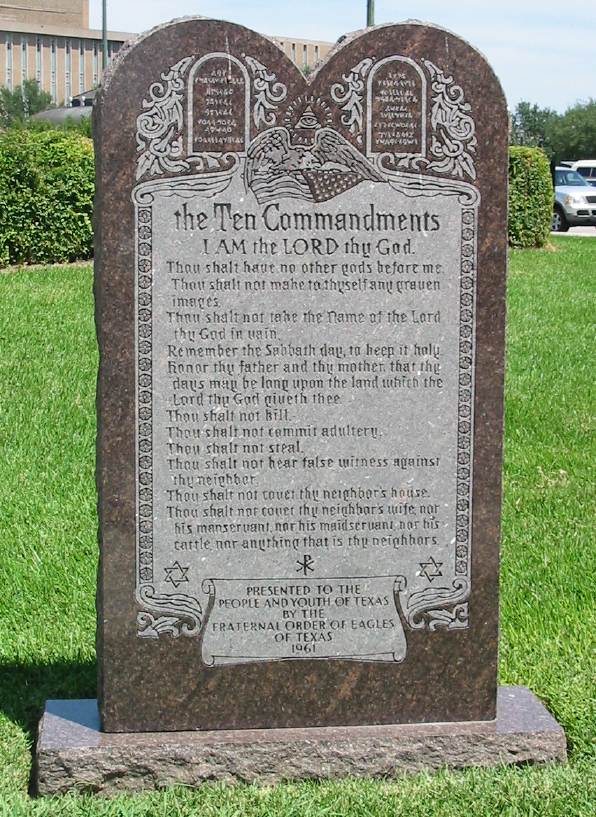
Van Orden vs. Perry (Gov. of Texas)
In 2005 the Supreme Court of the United States decided that a 10 Commandments monument could remain on the grounds of the Texas state house.
As a protest movement the so called “Temple of Satan” has been attempting to place a 2 ton bronze baphomet on someones statehouse grounds.
Two items of interest.
- Thousands of 10 Commandment statues were placed at courthouses and statehouses around the country in anticipation and the wake of Cecil B DeMille’s movie “The Ten Commandments” as promotion and as a part of a mid century movement that believed that Judeo-Christian values and free market capitalism were God’s design for the world.
- The Temple of Satan is really more of a humanist organization that gets attention by being shocking.
Tenets of the “Temple of Satan”
At the website you can find the tenets of the “Temple of Satan”
- One should strive to act with compassion and empathy towards all creatures in accordance with reason.
- The struggle for justice is an ongoing and necessary pursuit that should prevail over laws and institutions.
- One’s body is inviolable, subject to one’s own will alone.
- The freedoms of others should be respected, including the freedom to offend. To willfully and unjustly encroach upon the freedoms of another is to forgo your own.
- Beliefs should conform to our best scientific understanding of the world. We should take care never to distort scientific facts to fit our beliefs.
- People are fallible. If we make a mistake, we should do our best to rectify it and resolve any harm that may have been caused.
- Every tenet is a guiding principle designed to inspire nobility in action and thought. The spirit of compassion, wisdom, and justice should always prevail over the written or spoken word
The whole baphomet thing, and taking names like “Lucien Greaves” (real name is Doug Mesner) is more like a stunt to draw anger and poor behavior from religious people.
No 10 Commandments Statues in the Bible
With all the back and forth over this kind of thing no one I’ve heard has ever stopped to ask whether there is an actual command in the Bible to erect stone monuments with the 10 commandments. I’ve never found one. The closest we come is Deuteronomy 27 where God commands Israel to stones covered with plaster to put “all the words of the law” on them. We’re not quite sure what that meant, but they are then commanded to a covenant renewal ceremony not close to where they will be crossing, a ceremony that we have no record of them actually fulfilling, yet an interesting one. Six tribes on one mountain and six on another, one declaring blessings, the other curses, yet only the curses here are recorded.
12 Curses
The 12 curses, sometimes known as the dodecalogue have some similarities to the 10 Commandments but some differences too.
Before we get all post-Christian and badmouth the Bible and especially the Old Testament you might note that I think the vast majority of modern American readers could easily endorse the list. Among even my most atheist and irreligious friends few would object to statements against cruelty to blind people. incest, bestiality and real estate theft. The law has worn amazingly well.
Secularizing Curses
While secular modernists might express skepticism about the whole idea of curses they actually have a secular concept that expresses the idea in secular terms. Charles Taylor in his book A Secular Age tries to figure out why in 2000 it’s not assumed someone in the west will unself-conciously believe in God while in 1500 nearly everyone did. One of the narratives he notes the process of what he calls “providential deism”
In “providential deism” people began to feel that God didn’t just personally reinforce his commands in the events of people’s lives but rather or also built the world in such a way that if you do good things good things will happen to you. Soon it was a short trip for people to imagine that “laws of nature” or even “morality within nature” made things such so that if you did right things would work better for you. After a while God wasn’t even needed to back the system. We had science to explain to us why being kind to blind people, not having sex with close relatives or animals and having a system of laws about property and security were “good” for us. If we did good things we’d be blessed. No God required.
I suspect that if you put up a stone with a semi-edited version of these 12 curses and didn’t let anyone know they came from the Bible lots of people would say things like “Oh my, such ancient wisdom and good advice, even if it is a bit strange.”
Why Such A List Is Enduringly Helpful
Now we might ask why such a list, again, if we would hide its Biblical sourcing is so timeless and nearly universally accepted as being helpful. Why do we praise a list that we nearly universally can agree upon and why do we feel the need to promote such a list, elevated and celebrate such a list and promote it in a way to keep it in front not so much of us, but for “them”, the “others” that we imagine “need” this list more than we do?
First we imagine that celebration and repetition of such a thing will do people good. This isn’t without psychological and sociological justification. When cultures and groups of people agree and promote things they do in fact get into our culture and our behavior. We see this being practiced all the time. It is part of our faith in moralism and our faith in our ability to improve ourselves, our culture and our world.
Second we should observe that the need for such promotion doesn’t seem to go away. This too is important to note. We feel the need to promote such a thing because we do these kinds of things. All of this is within is and among us even if we’re ready to stand on a mountain side and shout it. We are big in display, but poor on follow through.
The plan of Deuteronomy seems pretty clear.
Deuteronomy 21:18–23 (NET)
18 If a person has a stubborn, rebellious son who pays no attention to his father or mother, and they discipline him to no avail,19 his father and mother must seize him and bring him to the elders at the gate of his city. 20 They must declare to the elders of his city, “Our son is stubborn and rebellious and pays no attention to what we say—he is a glutton and drunkard.” 21 Then all the men of his city must stone him to death. In this way you will purge out wickedness from among you, and all Israel will hear about it and be afraid. 22 If a person commits a sin punishable by death and is executed, and you hang the corpse on a tree, 23 his body must not remain all night on the tree; instead you must make certain you bury him that same day, for the one who is left exposed on a tree is cursed by God. You must not defile your land which the Lord your God is giving you as an inheritance.
The problem of course is with the afflicted son. They may be at wit’s end with their son and the law is fast and sure to resolve the vexation, at the cost of their son of course.
Christians Reading Deuteronomy
Throughout the sermons on Deuteronomy I’ve been asking us to try to read the book as Christians. We imagine we can easily take the book at face value and here is a text that it seems “all good people” can agree upon, even today when many “good people” disagree about a lot regarding morality. We approach the book with the haunting tension that on one hand life is unlivable without the law, on the other that we can’t life up to the law and we quickly become its victim or the law becomes a tool in our hypocritical hands.
The apostle Paul flips the script on the text in the book of Galatians, when the Christians are looking at the Old Testament as a prescription for achievement.
Galatians 3:10–14 (NET)
10 For all who rely on doing the works of the law are under a curse, because it is written, “Cursed is everyone who does not keep on doing everything written in the book of the law.”11 Now it is clear no one is justified before God by the law, because the righteous one will live by faith.12 But the law is not based on faith, but the one who does the works of the law will live by them.13 Christ redeemed us from the curse of the law by becoming a curse for us (because it is written, “Cursed is everyone who hangs on a tree”)14 in order that in Christ Jesus the blessing of Abraham would come to the Gentiles, so that we could receive the promise of the Spirit by faith.
So Can Both Be True? Do We Need Monuments?
I would have to say yes, but our monuments have to be understood in their context. The language itself is important. Blessed are you if you do these things. Cursed are you if you don’t.
The irony of de-mythologizing the curses into “natural laws” in “providential deism” is that it also removes us from grace. God is reduced to natural processes and Jesus becomes a nice idea without power or authority.
We do well to post the dodecalogue. As a culture we would do well to heed it. In our heeding we may discover that we are wretched and fail it. We may discover that our use of the law leaves us childless with hands full of stones.
We may also look to see our victim hanging from a tree, with Joseph of Arimathea claiming his body. We may look on as faithful, diligent women hurry to the grave on the first Jewish work day of the week to do what is necessary for the body only to discover it is gone.
Yes we would do well to heed the words on the stone, but we should heed the man who was hung on a cross even more.


 Leadingchurch.com