
Spirituality comes Naturally
Despite what newbie atheists say, there is nothing so natural as spirituality. Humanity has always been spiritual. You can’t possibly do any digging into history, especially everything before the enlightenment to see that we are a thoroughly spiritual animal. Getting beyond spirituality is something of an achievement only mastered by a few Greeks and now the secular modern world that feels itself to be the pinnacle of human civilization. Some have even gone so far as to suggest that spirituality and religion will evaporate like morning fog leaving us to recognize are pure animality and rationality even though some like Sam Harris are either backsliding or indulging in spirituality for purely recreational purposes.
We are spiritual because we are ardent opportunists and the world is a devilishly dangerous place. As a pastor I ask people sometimes “can I pray for you” and I very seldom get a “no” for an answer. Even if people don’t believe in God or much “spirituality”, from their point of view what could it hurt if I say a few words into the air. What’s the downside of me leveraging my foolish belief?
Our focus in our journey through the Bible has obviously been on the Ancient Near East between Egypt and Mesopotamia in the land the Egyptians called “Canaan”. What you find in Canaan before 1000ad is what you find everywhere else on the planet, a world full of “spiritual” people.
We as modern, wealthy, Western middle-class people feel ourselves to be in control of our fortunes, at least until a drought, a hurricane, an earthquake, or other forceful human beings disrupt our plans, but the ancients took a lot of stock in working the spiritual forces of their environment in order to secure for themselves successful agriculture, breeding, mating, business and warfare.
Spiritual Freestyling
The best thing about spirituality is that it always feels authentic, whether you’re doing it alone in a group gathered together because of their shared experience. Spirituality can be fun, wild, exciting and sometimes dangerous. In our individual culture it tends towards individualism. In a tribalistic culture it tends towards tribalism. Spirituality is like a mirror, it can reflect back to us our “best” most aspirational self. We might be a nobody in regular life, but via spirituality we are gods, goddesses, queens, kings, filled with power and beauty and horizonless possibilities.
Last week we talked about the “nones”. Many nones aren’t necessarily atheists. Many are “spiritual but not religious”. Spirituality is a libertarian dream. Do whatever you want, think however you feel, no one can judge you, critique you, or try to fence you in in any way. You can be spiritual any way you want to. What could be better? Religion is a downer of rules, other peoples limiting ideas, “no”, and stuff you don’t have time to go into or explore. Spirituality is fresh every morning, always authentic, always “just in time”, always perfectly and uniquely you.

Settling Into the Promised Land
In our way through the Bible Joshua has died of old age having installed Israel in the land and apportioning it out to the tribes. If you look at a map you see these nice boundaries with tribal names on them and we imagine countries like we have today with governments and languages and passports and borders. The truth on the ground, however, was way more complex. If you recall from our conversation at the beginning of Joshua Canaan was actually a hodge podge of city states and ethnic groups who tended to be suppressed when major empires arose but between those times they fought among themselves and did to each other like the major empires did to them.
It’s hard for us to imagine life in such a situation but this way of being was actually very common throughout the world. In many ways it’s the “law of the jungle”. Watch PBS about lions. It’s basically never ending gang warfare where violence is common and one of the chief ways of making in the world is intimidate your neighbor and if you have the strength steal their crops, their animals, their slaves and their family and make them your own.
According to the story groups of Israel had settled throughout the region but they were not the dominant power. They were challenged to “go up” to take the land and dominate it, clearing out the competing peoples.
Ethnic Cleansing and Power
I just finished reading Bloodlands; Europe between Hitler and Stalin which is the history of Eastern Europe in the 30s and 40s. This was one of the most horrible stories I’d ever heard of. Hitler and Stalin both tried in their own ways to clear the land between Russia and Germany of its people, Jews and sometimes everyone. Poland, the Ukraine and the other areas were devastated by waves of attempts to de-people the land or subjugate the peoples as laborers so that food could serve their respective homelands.
It is tempting to think about Canaan in the same way, but there are some differences.
German and Russia were to Poland and the Ukraine as Mesopotamia and Egypt were to Canaan. Israel was not a major power. They in fact were behind in technology, didn’t have iron making and as we saw with Jericho were no match even for walled cities.
Archaeologists in looking at this period have wondered about the fact that they didn’t find evidence of a widespread invasion of the land during this period. A close reading of the text of Joshua reveals that it only claims that three cities were burned: Jericho, Ai and Hazor. This together with the picture we get from Judges 1 and 2 seems to indicate that while Israel “moved into” the lands, they by no means were dominating them nor were they able to do it by their own strength.
“Go up and take the land”
Judges 1 and 2 faults Israel for failing to complete what the LORD commanded and what Joshua began. Israel did not “go up” and take the land. Why not? Was she lazy? Did she lack ambition?
It seems that this finishing the job required something of Israel which she had always lacked, faith. Israel seemed to be able to muster faith only when she was well led, like by Joshua and Moses, but even in those times she often failed, rebelled or simply flaked. At the death of Joshua Israel seemed in fact to “settle”, mostly because she had no faith. I’m sure Israel would have loved to take the cities and occupy them, to take the fields and the property of her neighbors, but it seems the reasons she didn’t was that she could not.
The emphasis of Judges 1 in fact is that this “taking the land” was always the LORD’s work. Israel had to express some faith to participate, and this seems to be exactly where the lacking was. Judges 1 gives evidence of some initial attempts but most it gives evidence of not attempting anything at all.
What to Do with Us
Judges 1 highlights the tension of the entire enterprise of Israel that began way back in Genesis. What to do with us? Our rebellion, our flakiness, and most of all our spirituality. We’ll come back to the spirituality part because it plays more of a role than you might imagine.
Judges 2:1–5 (NIV)
1 The angel of the Lord went up from Gilgal to Bokim and said, “I brought you up out of Egypt and led you into the land I swore to give to your ancestors. I said, ‘I will never break my covenant with you, 2 and you shall not make a covenant with the people of this land, but you shall break down their altars.’ Yet you have disobeyed me. Why have you done this? 3 And I have also said, ‘I will not drive them out before you; they will become traps for you, and their gods will become snares to you.’ ” 4 When the angel of the Lord had spoken these things to all the Israelites, the people wept aloud, 5 and they called that place Bokim. There they offered sacrifices to the Lord.
Their failure to take any faithful initiative had brought God to the point of leaving Israel to her own devices. It’s kind of like saying “you don’t trust me to do my part, even enough to start doing what I ask of you, so I’ve decided to fulfill your doubts and not do what I promised to do. In a sense I’ll give you exactly what you asked for and expected from me.”
Israel, Spiritual but not Religious
Beneath this pronouncement by God’s messenger is an acknowledgement of what had been happening. Israel moved into the land with her natural spirituality and began to do simply what people do.
Judges 2:11–13 (NIV)
11 Then the Israelites did evil in the eyes of the Lord and served the Baals. 12 They forsook the Lord, the God of their ancestors, who had brought them out of Egypt. They followed and worshiped various gods of the peoples around them. They aroused the Lord’s anger 13 because they forsook him and served Baal and the Ashtoreths.
Now how did this work?
Spirituality, Psychology and Sociology
One of the amazing things about American “spirituality” is that it naturally follows the contours of our culture, individualism. Americans imagine that their “spirituality” is truly unique, authentic, and true for them. If you read David Brooks’ The Road to Character you’ll see an exploration at how Americans imagine they have within them a golden, “true self” that if they, through trying on lots of spiritualities and practices they will discover. How does Brooks discover this? Like Yogi says, “you can observe a lot of things by just watching.” Try it sometime.
You see it in teenagers. They’re all out there trying to “be themselves” trying to “be authentic”, trying to “be true to themselves” and they all wind up doing mostly the same things. Why?
It always amazes me that when people sometimes look for “spirituality” they forget basic psychology and sociology. Human beings are one of the most communal creatures on the planet. We instinctively and naturally mirror each other, copy each other, and believe in groups, even if we don’t realize it. We forget that we are all feeling and going the same thing. It’s how we started learning and why we started learning as infants and toddlers and unless we actually decide to take a step back, we do it instinctively, automatically and naturally.
When it comes to what we label “spirituality” it is where we go.
Israel moved into the land and simply started going what everyone else was doing.
Spirituality by Consensus
In the 1980s a Christian English professor named Virginia Stem Owens teaching at Texas A&M tried something out.
Most of the students at my university come from middle-class, conservative, Republican families. The vices here, like the values, are traditional—weekend drunkenness and sexual promiscuity. Things a parent can understand.
Therefore, when I assigned my freshman English class “The Sermon on the Mount,” a selection in their rhetoric textbook taken from the King James Version, I had expected them to have at least a nodding acquaintance with the reading and to express a modicum of piety in their written responses. After all, Texas has always been considered at least marginally part of the Bible Belt.
What did she discover? Her students were horrified by what they found.
“The stuff the churches preach is extremely strict and allows for almost no fun without thinking it is a sin or not.”
“I did not like the essay ‘Sermon the Mount.’ It was hard to read and made me feel like I had to be perfect and no one is.”
“The things asked in this sermon are absurd. To look at a woman is adultery? That is the most extreme, stupid, un-human statement that I have ever heard.”
She was floored. This isn’t California in 2015, this is Texas in 1985ish.
She goes on to make this observation.
Unfortunately, I have yet to come across a student who sees any logical contradiction between this morality-by-consensus stance and their favorite proverb. Who’s to say? It’s different things to different people.
Do you understand what she is saying? (read the whole thing).
We practice morality by consensus and spirituality by consensus and then blithely wave an practical libertarian flag. We don’t see the contradiction because nearly everyone around us embraces the same contradiction.
Spirituality Unleashed
Despite the applause the Pope received on his visit to America, the rise of the “nones” is the rise of the “spiritual but not religious”. Many of these folks believe that the world would be better off if everything was spiritual and nothing religious. What they practically pursue in their lives is pure spirituality, zero religion. What they mean by that is that the world would be a better place if the established religions, especially the Abrahamic religions, had never been.
I’ve got good news for you. I have raw material for your thought experiment. Go back in time by reading history and you can find a world without the Abrahamic religions, a world of that free spirituality you dream of. Want to see it? What did it become?
Your Most Free Spiritual Self Now
If you were to truly let loose and find the most you, the most unrestricted spirituality imaginable, what would it look like? Would it involve pleasure? What kinds of pleasure? Would it involve wealth? Security? Having other people do as you would like them to do, since people doing what you don’t want them to do is often the source of your greatest miseries. Would it involve looking for powers, spiritual powers that could deliver on giving you what you desire? Would you look for spiritual vendors who offered to make your strong, powerful, beautiful, successful, in control of yourself and able to shape your life (and others in it) according to what you think is beautiful and desirable? Well this all is the game isn’t it?
There’s always a catch
Here’s the catch with all of that. As long as you are at the center of your own spirituality and therefore you own picture of your preferred world, it all sounds great. But what happens if its someone else doing the desiring? What happens if the other wants to have their cake and eat it too and you are the cake? What happens when you used to be the cake but you’re not anymore? What happens when you are not the consumer but the product?
In the competitive race for spirituality and spiritual vendors very quickly people become not only the consumers of spiritualities but also the products. What happens when you are on the wrong side of someone else’s spirituality? Maybe their “best life now” used to include you, but since then they’ve found someone wealthier, more beautiful, younger, more exciting in order to have their best life now? Where does that leave you? What happens when everyone is playing the same game all at once?
What happens is that those with more power begin to dominate those without and they derive a million “spiritual” reasons why the use of that power is justified. And what you have is Canaan with Israel hoping to compete in the games.
Misery: Israel Can’t Compete in the Spiritual Marketplace
Israel’s trouble is the same trouble she’s had all along. In Egypt she didn’t have power so she became Egypt’s slave. Now in Canaan God has brought her into the land and was ready to make a place for her if she’d only go up, but she was scared, or apathetic, or untrusting or unfaithful and she didn’t. So God gave her exactly what she wanted. What devolved was a pattern. This is the pattern of the book of Judges.
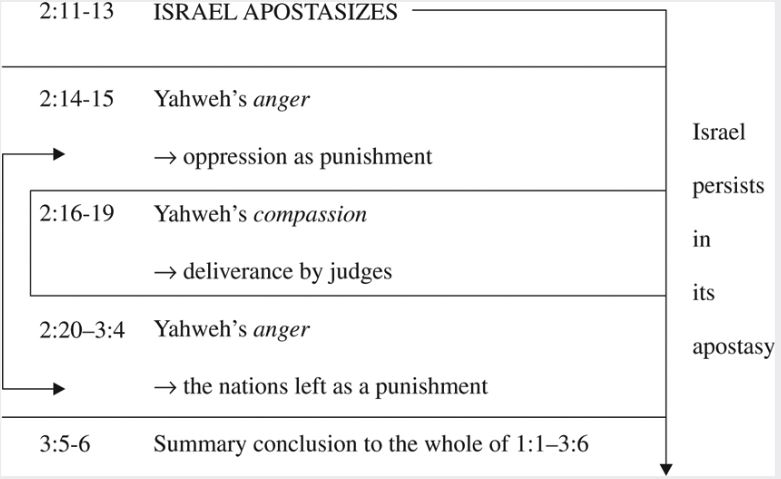
From Barry Webb The Book of Judges
Israel perpetually becomes the victim of the game and subsequently the victim of her “spiritual” neighbors.
True Religion is the Opposite of “Spirituality”
The bad reputation that “religion” has is well earned. The word “religion” comes from the Latin which means “to bind” or “obligation, bond, reverence”.

People are right when in a way they contrast “spirituality” and “religion”. Spirituality wants to stick to a libertarian line “as long as no one else gets hurt” but spirituality commonly winds up using others for your own pleasures, amusements or needs. True religion is the opposite thing.
In a sense what Yhwh does to Israel, to the degree that he can stand it, is to be “spiritual” to Israel. Israel cramps Yhwh’s style. Israel is costly. Israel takes but doesn’t give. Israel is a drag.
What Yhwh keeps doing, however, and this is the story of the book of Judges, is bailing Israel out when her pain gets too great for Yhwh to stand. He comes back, forgives, wades in, and once again bails her out as her “spiritual” neighbors have begun to enslave her once more. This is true religion.
Deliverance: Jesus
We will meet in the book of Judges lots of rescuers. Many of these rescuers will not be “good people”. God will use them to rescue Israel from Canaanite “spirituality” again and again, but Israel won’t stay saved.
In many ways the entire Old Testament leading into the new is the same story. In Jesus God decides to finally conquer the script.
“Spiritual” Israel in the Old Testament is like someone addicted to the Home Shopping Network and in credit card trouble. In the book of Judges God keeps making the minimum payment, giving a reprieve for a while, but Israel is an addict.
In the New Jesus comes and wipes the cards clean, restoring bad credit, and through Jesus puts a mirror up to ourselves asking us to see ourselves and him.
Gratitude: True Religion
The book of James says this:
James 1:26–27 (NET)
26 If someone thinks he is religious yet does not bridle his tongue, and so deceives his heart, his religion is futile. 27 Pure and undefiled religion before God the Father is this: to care for orphans and widows in their misfortune and to keep oneself unstained by the world.
Now you might say “yeah, that’s the kind of spirituality I like, not that Canaanite stuff.” But do you realize that if the reason you help the poor, the widow or the orphan is because you want to feel good about yourself then you have used their misery as a tool for your own enjoyment and fulfillment? Do you see how tricky this is?
Even if you decide you’re going to do this in order to work your way to God you have done exactly the same thing. The poor, who are used by this world for the wealth and pleasures of others have not become your tool in the game of your own ego.
True and pure religion is to do this out of gratitude for what God in Jesus has done for us. Our natural impulse is to use others, my well-being at the expense of others. Jesus does exactly the opposite and the Christian life is an invitation into gratitude, to do what he did for us, for others.


 Leadingchurch.com