
“If I were God…”
Last week we mused a bit on the search query I found on my blog post “why religion doesn’t work”. Connected to this question and connected to our doubts are both our questions about God’s administration and His seeming silence to our pleas.
While I have always enjoyed the stories in the book of Judges I had never before considered how this book relates to these questions. The book of Judges holds up to us two realities in stunning contrast, God’s interactive willingness to intervene in our bloody affairs right next to the brutal episodes of human violence and rebellion.
Accounting for the Squeemishness of Western Comfort, Security and Affluence
The book of Judges is bloody and brutal and it raises questions and issues for us in terms of God’s involvement in human brutality. While I think these are legitimate issues to raise I think we should also acknowledge our own context in raising them. For those of us who are white, sitting securely in the middle of the world’s superpower with armed police ready to respond to cries of distress we have little credibility when it comes to assessing the desperation of those whose lives are ripped apart by everyday violence and brutality. The kind of God victims of warfare and violence are looking for is one that will bring the wicked to a swift, violent end. We cheer for this from the safety of our theater seats as movie after movie depicts violent human heroes killing the bad guys. How strange our amnesia.
I think about Elie Wiesel in Night telling the story of Akiba Drummer losing his faith in the Nazi work camp.
He was old and bent, his lips constantly trembling. He was always praying, in the block, at work, in the ranks. He recited entire pages from the Talmud, arguing with himself, asking and answering himself endless questions. One day, he said to me:
“It’s over. God is no longer with us.”
And as though he regretted having uttered such words so coldly, so dryly, he added in his broken voice, “ I know. No one has the right to say things like that. I know that very well. Man is too insignificant, too limited, to even try to comprehend God’s mysterious ways. But what can someone like myself do? I’m neither a sage nor a just man. I am not a saint. I’m a simple creature of flesh and bone. I suffer hell in my soul and my flesh. I also have eyes and I see what is being done here. Where is God’s mercy? Where’s God? How can I believe, how can anyone believe in this God of Mercy?”
Poor Akiba Drumer, if only he could have kept his faith in God, if only he could have considered this suffering a divine test, he would not have been swept away by the selection. But as soon as he felt the first chinks in his faith, he lost all incentive to fight and opened the door to death.
When the selection came, he was doomed from the start, offering his neck to the executioner, as it were. All he asked of us was:
“In three days, I’ll be gone … Say Kaddish for me.”
We promised: in three days, when we would see the smoke rising from the chimney, we would think of him. We would gather ten men and hold a special service. All his friends would say Kaddish.
Wiesel, Elie (2012-02-07). Night (pp. 76-77). Farrar, Straus and Giroux. Kindle Edition.
The Jews in these camps knew their Hebrew Scriptures. They knew how Israel both rehearses the stories of the Exodus, professes the willingness and ability of God to defend the righteous while also openly asking the hard questions about when God doesn’t seem to show up leaving them to suffer and die in misery and oppression.
Gideon’s Dreamily Direct Relationship With God
The Gideon story begins like a dream. Gideon is threshing wheat in a winepress because the Midianite oppression is so great and pervasive. They must hide their food lest it be stolen. It reminds me of Joseph Stalin’s forced famine of the Ukraine in 1932-33.
The LORD shows up to Gideon and many aspects of the encounter and the relationship echo the call of Moses. Gideon is skeptical and hesitant but lead by the LORD’s call and miraculous signs and wonders all along the way through Gideon the LORD delivers Israel from the Midianites.
The Gideon stories provide some of the most memorable stories from the book of Judges. Gideon’s fleece with its double confirmation, winnowing Gideon’s army from 10,000 to 300 and then their defeat of the Midianite multitude. These stores are staples of children’s story books and favorites of children learning about the Bible and who God is.
Isn’t this exactly the kind of relationship with God we fantasize about? God hearing our prayers, defeating our enemies and leading us into greater and greater faith with each miraculous and dramatic turn in the story.
Where the Storybooks End
If you went to Sunday School as a child you remember Gideon, but you probably don’t remember all of the stories. The Gideon stories actually raise very important themes about leadership, power and kingship. After the big victory with the trumpets, the torches and the jugs Gideon will pursue his enemies over the Transjordan. He will brutalize two Israelite communities that refuse to give him and his soldiers assistance and will ask his son, still a youth, to execute those kings for having killed his two brothers. He will take after Aaron by collecting earrings but in place of a golden calf he will make an ephod which will becomes a stumbling block to Israel in the future. Israel’s desire for a king and his own behavior will set up what is to come with his son in the next chapter. Reality becomes far more complicated than the halcyon days of Gideon, the fleece and the rout of Midian.
Ministry Stories
Ministry stories are often crafted like children’s Bible story books. The hero, the reliable God who shows up just because we call, the dramatic victory, the “happily ever after” ending. This may be our retelling of Judges, but the real text is more real.
Our fantasies about how God should work are really fantasies. Like most fantasies they live better in our imagination than they do in the real world. With Gideon the book of Judges shows us how it goes when “God shows up”. This point of this isn’t that God is unwilling, it is that our stubborn rebellion is real and is in the final analysis what really needs to be dealt with.
Jesus in Galilee
It is important to help the book of Judges teach us about Jesus. If you read the canonical Gospels Jesus’ time of ministry in the Galilee are his halcyon days in many ways. Huge crowds followed him because God was “showing up” in Jesus. People brought their sick and their were cured. Food was multiplied, the blind saw and the deaf were healed. Jesus in now ways undermines the importance of this ministry. In fact he holds it up to John the Baptists’ doubts as evidence of the invasion of God’s reign, when that invasion didn’t look like John was expecting it.
It’s also important to note in this how expectations are always more varied than we think. God didn’t do healing miracles with Gideon like he did with Elisha and Jesus, he moved a military/political obstacle through Gideon. If Jesus had worked on that front he would have pleased the Pharisees and Zealots.
Jesus’ miraculous ministries didn’t move on a theological front quite like Gideon’s. We see Gideon pulling down the altar of Baal and cutting down the Asherah pole. We don’t see Jesus attacking signs of pagan worship. This too would have received support from the more conservative Jewish factions.
Recently in the Sacramento News and Review they did a “person on the street” type survey of what Jesus would do about poverty.
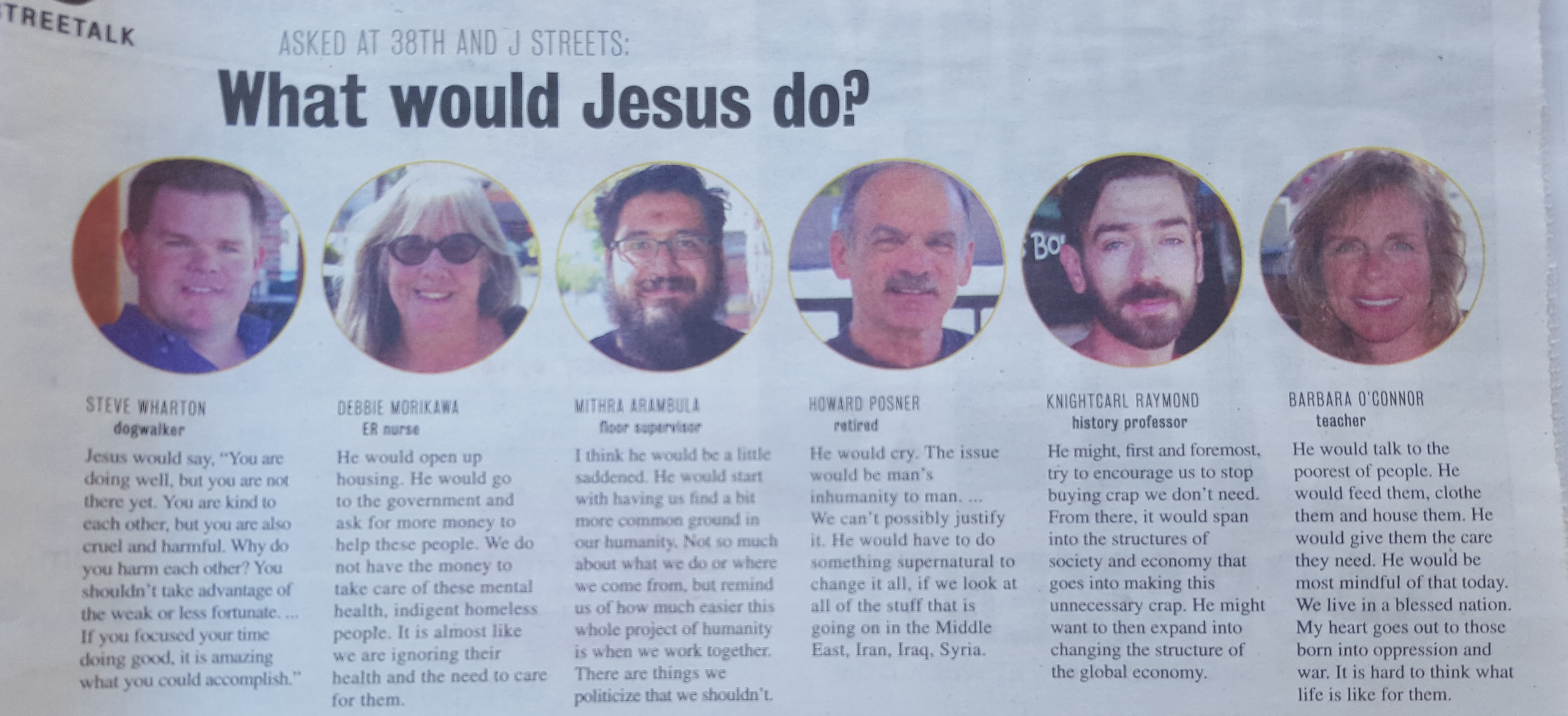
What struck me about all the answers were how they reflected their own expectations about “the good”.
What’s stunning about Jesus’ popular Galilean ministry phase is how unsuccessful it was in terms of the kind of long term change. Everyone who ate multiplied loaves would be hungry again. All those who were healed or raised by Jesus would get sick again and die. In that way the short term fantasy stories match. Through Gideon God beat the Midianites but they would be enslaved soon enough by the tyranny of Gideon’s son and then by the Philistines. At each turn the fly in the ointment isn’t really power or politics, it is us.
The Strange Shape of Jesus’ Ministry
This of course leads in Jesus’ case to the strange turn of his ministry, the turn to Jerusalem. The opposition to this turn by his disciples represented by Peter was completely logical. Galilee was a success. Crowds were following him. Jesus didn’t need a political adviser to know what the next steps were? Once you’ve got crowds and popularity you turn that into political power to effect the changes you want. This of course was the course of Gideon, and as we saw a bit in Sukkoth and Peniel and the ephod it all comes undone in enough time.
We even see that with the church. Churches and ministries rise, grow popular, gain support, gather resources, but they are undone, stumble, fall, etc.
Paul says in 1 Corinthians that the cross is the wisdom of God. It is in the cross and resurrection that we see the shape of our redemption.
What no one expects of God’s intervention is crucifixion and the invitation to take up our crosses and follow him.
The Toughest, Slow-Motion Miracle
What the Gideon story of Judges illustrates, along with the rest of the Bible and human history is that God’s most determined adversary is us. God can make a meal go up in flames, dew fleece or the ground on alternate days, use a few hundred men to rout tens of thousands, but the stubbornness of our rebellious hearts that result in the calamity of human history, this requires the kind of dramatic, drastic, incomprehensible sacrifice of the cross, the resurrection and the gift of the Holy Spirit, and even then we stumble around.
What the prideful boast of “If I were God I know how’d I fix this mess” truly reveals is out own cluelessness about humanity’s problem and our own. The last thing on that list would be exactly the path that he took, the road to Jerusalem and the cross. How do we know this? Because this is exactly the path he invites us to follow, and it is a path we usually doubt.


 Leadingchurch.com
Pingback: When the Trees Look for a King | Leadingchurch.com