
 “Oh my, it’s GOD!”
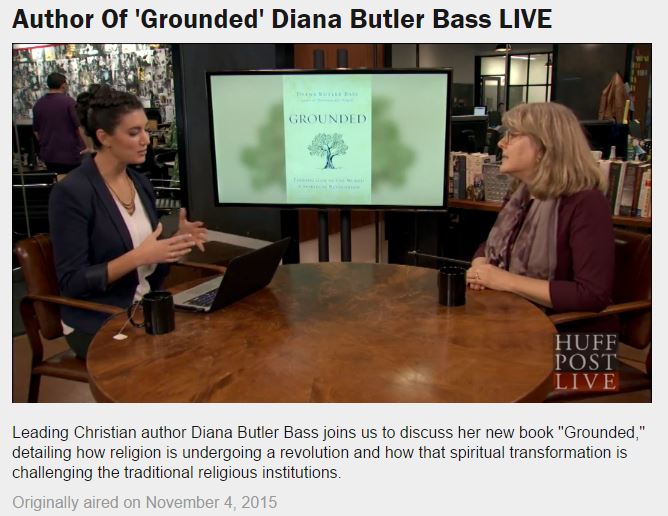
A common narrative today is that Americans are getting less religious, in the terms we easily identify as religious, but still “spiritual”. In a Huffington Post video Diana Butler Bass talks about her new book Grounded and talks about this “revolution”.
In this video she shares a person anecdote (early in the interview) of wandering into a historic Quaker meeting and having a strong experiential reaction to the building that puzzled her. Three years later in doing some genealogical research only to discover that her first ancestor on her mother’s side to come to America was wed in this meeting house.
Many evangelicals might call this “a God moment”. I wonder if someone from an Asian or African culture might associate an experience like this with their connection to their ancestors. Bass is a mainline Christian which places her in a decidedly secular frame that tends to dismiss such experience as random or superstitious.
When I listen to this new mainline fascination with spirituality part of me wonders where they have been. In the churches I frequent we’re awash in spirituality. God shows up all over the place. Bass here is kind of like former California Governor Bigler who named Lake Tahoe after himself after the European’s “discovered” it. You can just imagine the indigenous populations all around saying “you mean this lake we’ve been living by for hundreds of years? New to you maybe…”

Taming God
Part of the difficulty with God siting isn’t that they are too rare, it’s that they are too wild. If you think that kids say the darndest things try God. People are always hearing God, feeling God, finding God telling them who to date, how to get money, and where to find parking spaces. Often as pastor the problem isn’t that “God” is too absent, it’s that “God” is too erratic. Part of what frustrates people about “religion” is that religion is always trying to tame God, to say “this is of God and that isn’t of God” and to hem him in with holy books, doctrines, laws, rules and clerics.
On one hand Bass is so excited to find God in her supernatural experience at the Quaker meeting house yet the God she finds fits comfortably within the confines of her life, something like an exciting story found in an old book read on a comfy sofa by a warm fire. A bit later in the interview we find the implicit message that the veracity and authenticity of this god is validated by the fact that zhe subscribes to the hallowed list of social justice causes (discussion starts at minute 12).
The problem of course is that off reservation God experiences can be just as prone to violence, sexism and all manner of things as can good old-fashioned religious dogma.
We’d rather have “God like us” than “God with us”
Skye Jethani in his book With tells the story about New Testament professor Scot McKnight’s little test he gives every year
Every semester Scot McKnight, professor of religious studies at North Park College in Chicago, gives his students a test on the first day of his Jesus class. The test begins with a series of questions about what the students think Jesus is like. Is he moody? Does he get nervous? Is he the life of the party or an introvert? The twenty-four questions are then followed by a second set— with slightly altered language—in which the students answer questions about their own personalities.1
McKnight is not the only one who has administered this exam; it has been field tested by other professionals as well. But the results are remarkably consistent—everyone thinks Jesus is just like them. McKnight added, “The test results also suggest that, even though we like to think we are becoming more like Jesus, the reverse is probably more the case: we try to make Jesus like ourselves.”2 McKnight’s personality questionnaire confirms what the French philosopher Voltaire said three centuries ago: “If God has made us in his image, we have returned him the favor.”3
Jethani, Skye (2011-08-22). With: Reimagining the Way You Relate to God (Kindle Locations 865-874). Thomas Nelson. Kindle Edition.
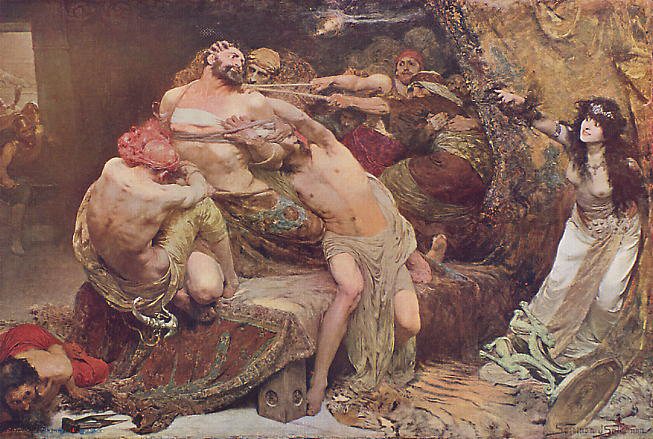
Nazarite Playboy Becomes spurned-Philistine Terrorist
One of the reasons Bible reading is so foundational if you want to stand any hope of hearing and seeing God outside your cultural filters is because again and again we see God using unlikely people to our moral imaginations to do things that look unholy to our religious appetites. One of the greatest such figures is Samson.
The Samson story begins, as many do in the book of Judges at an especially dark time for Israel. God had rescued Israel numerous time from Canaanite oppressors but now she had been subjugated for forty years by a people group that make the Canaanites look literally stone-aged. The Philistines were likely the dreaded “sea peoples” who ravaged the ancient world not unlike the Vikings terrorized Medieval Western Europe. In the case of Canaan they had moved into the coastal cities and made themselves a home, subjugating the population there including Israel and inclusively taking to themselves the Canaanite gods. Israel seemed so utterly demoralized the Judges pattern is broken here in that she doesn’t even call to Yhwh for help. Israel it seems is lost, backed into a corner with no way out.
Another Barren Woman Story
The Samson story begins with what Old Testament scholars call a “type story”. Just like Abraham and Sarah we meet an unnamed woman who can’t conceive a son. This woman’s predicament is Israel’s predicament. For her there is no way out. She is cut off. If her husband is smart he’ll abandon her and shop around for a woman who can accomplish what her culture assumed gave her value.
Unlike religiously fervent Hannah in a similar dilemma at the beginning of the book of Samuel we don’t even find this woman praying. She is not seeking “spirituality” to our knowledge, she is just there, unnamed, without resource. Unlike Mary the mother of Jesus who is a virgin we have no idea whether or not this woman has any virtue at all. It seems “God moments” can come upon anyone, at any time, for any reason God chooses.
This “angel of the Lord” shows up to tell her she will have a son, and he will be from birth a Nazarite, someone separated by oath in dedication to God. He will deliver Israel out of its own barren corner out from the bondage of the Philistines.
This poor women doesn’t know what to make of it so she tells her husband who is named Manoah. He seems to have some religious or spiritual knowledge about him and he’s probably more than a little skeptical about his wife’s “spiritual” experience so he prays that God would do him the favor of informing him of this “God thing”. God answers his prayer but again in a frustrating way. The angel shows up again, but again to the woman and she runs and finds her husband. The angel won’t give him the time of day or answer his questions, he mostly repeats himself. When the man presses for details the angel simply tells him that his name is too “wonderful” for him. This is all beyond his comprehension and he should stop trying to appropriate all of this. This is God working and he should just get with the program.
What follows is a rehearsal of the scene with Gideon where the angel of the LORD waits around until a sacrifice can be prepared and then he goes up with the fire. The man with the theological training has a fit while his wife has a bit more common sense than he does. In any case we imagine the couple is thrilled with delight not only that God has seemed to step in on their behalf. Not only will they have a son but this son will be God’s deliverer who will save Israel from the Philistines. The couple has absolutely no idea what they are in for.
All Strength and No Wisdom
As Samson grows up we see that on one hand he is “blessed” by God. He’s got good parents who love and care for him, but Samson is deeply flawed. Samson is all strength and appetite and it seems what he really has a taste for is Philistine women.
This sets up for us the deep ironies of this story and the deep way that through Samson God is illuminating who Israel is. Israel has always had a deep taste for the fertility gods of Canaan. Israel has lost all of her miraculous strength by chasing after these gods, and this will be precisely Samson’s story. Beneath, however, just like in Lewis’ “deeper magic” of Narnia, through Samson’s flaws the LORD will save Israel.
The Irony of the Nazarite Vow
The Nazarite vow was normally a short term vow of consecration. Samson’s life was supposed be an enduring incarnation of that vow. It would be Samson’s apartness that gave him his great strength, made him unbindable (by Judah) and uncageable (by Gaza). That Nazarite vow was a ceremonial intensification of who Israel was intended to be, God’s first born, his holy priesthood, his anointed.
Samson’s life, however, like Israel’s, was exactly the opposite. He saw the Philistine women and wanted them. Again and again he was no the brink of becoming one of them (notice the failed marriage to the girl at Timnah) but was always rejected and in the insult would kill and destroy. The Philistine women like Israel’s Canaanite gods would tease Samson/Israel, lure him in only to betray him. The betrayals, however, would set up the circumstances by which Samson would finally triumph over the Philistines and God would triumph over the gods of Canaan and their ways.
Samson, like Israel, was always running away from the differentiating vow that gave them identity only to in the most indirect way fulfill it.
Conquered by Love
Love also comes into play in the story. It is God’s love for Israel that brings him to intervene in Israel’s misery unbidden. Samson is filled with lust, but it is only when he actually lets love in that he is bound, blinded, and arms stretched out.
The story of Samson is a story of his relationship with three women. First his failed marriage to the girl at Timnah, next the prostitute at Gaza, and last the most famous of the three, Delilah in the Valley of Sorek.
The wife of his failed marriage caves into the threats of her countrymen to betray the trust of her husband. Through complaints of “you don’t love me” she gets out of Samson the secret to the riddle he used to chide his duplicitous brides-men. We learned that Samson wanted his wife, but it doesn’t say he ever loved her. He learned that letting her into his heart, just as he feared, meant vulnerability, something only his divinely endowed strength could rescue him from.
The second woman was a half-a-night-stand. Gaza was to be his prison but he not only broke the gates but carried them off, making Gaza as open and vulnerable as the whore he saw, wanted and plowed earlier that night. Samson was having his way with the Philistines.
In Delilah, however, Samson meets his match. This woman he loves and he will learn what love demands. Samson cannot be beaten by strength, only by love. This again is Israel’s story. How many times since the Exodus haven’t we seen who when she is threatened God provides supernatural strength to her armies through Moses, Joshua and Gideon. Israel cannot be beat by force of arms when God has her back, what beats her again and again is her love for the gods of Canaan. She plays the harlot as the prophets say and goes after her lovers and in their arms she is undone.
So as the famous story goes Delilah, who only for the sake of money trades on Samson’s love. Samson’s love for her isn’t informed by the three episodes of obvious betrayal. Love conquers all. Samson will finally let her in, the one that shouldn’t be trusted, the one who herself is bought with mere money, and Samson is betrayed.
Samson and Jesus
Samson seems closest and furthest from Jesus at the same time.
- Both are prophesied from birth to be deliverers of Israel
- Both are products of type stories, one of barrenness and the other virginity
- Both exemplify Israel in her mission and her call
- Both are moved by the Spirit of God to do the work of God
- Both are unconquerable by the violence of their enemies
- Both finally become victims of their enemies because of love
- Both die humiliated with arms outstretched
- Samson is violent, Jesus is peaceful
- Samson is a slave to his desires, Jesus is master of himself and all
- Samson runs away from his vow and call, Jesus stays faithful to his
- Samson exemplifies Israel’s failure to her calling, in Jesus the call is fulfilled
- It is at the cost of their lives that God accomplishes his work through them
The Spirit of God
We are offended at what Judges says God’s Spirit does with Samson. God’s Spirit offends our social justice sensitivities. It terrifies us when we discover it is not something we play with or employ, but rather it employs us. We are angered by the fact that it cannot be used to embellish our comfy private stories but rather it uses us to write the story the Spirit wishes to create.
- The Spirit drives him to see the girl at Timnah which sets up the disastrous marriage
- The Spirit comes upon him to kill the lion with his bare hands
- The Spirit drives him to kill 30 Philistines in order to take their clothing to repay the debt made by his wedding wager
- The Spirit came upon him when being turned over by Judah to the Philistines to slay 1000 of them with the jawbone of an ass
- God leaves him when for love he lets Delilah in and she she cuts his hair.
- God empowers him one final time to take the life of 5000 rules of the Philistines
This Spirit is not some cozy feeling to liven up a dreary afternoon because our controlled and predictable lives could use a little spice. God is wild and free, writing the script, giving and taking away, as he pleases according to the story He wishes to write. Spirituality in our own image is usually just an expression of our will and desire.
The Shocking Cost of Love
What we find in the story, however, is that where we see God in this story most is in the weakness and failings of Samson.
The part we play in our story with God is not so much Samson but Delilah. We sell our selves and bodies for money. We betray the one that desires us to his enemies. It was Jesus who came in love, let us into his hearts and for 3o pieces of silver sold him to become the humiliated entertainment of his enemies.
To be a Christian is to be a repentant Delilah. The story tells us nothing, but if Delilah knew the love he had for her, and saw in his sacrifice the value of that love, it would change her. To be a Christian is to be changed by that love and then to see not simply the fall of the temple of Dagon, but the resurrection of the temple of the LORD which was from the start and has always been his creation.
The problem with Delilah is that she might crassly imagine, and with good reason, that Samson is just in it for the nooky. If she has anything left of her created goodness remaining within her she might see that there, between her knees, is a man who opens himself up completely for her at the cost of his life. She imagined he thought her a play thing so she would use the game for money. (How often isn’t it God or money?)
Jesus comes and plays Samson to the world as Delilah. God so loved the world, remember?
Now, each of us, playing our own Delilah must decide what part we will play.


 Leadingchurch.com
Pingback: How We Use Spirituality to Give Us the Life We want, and why it always fails | Leadingchurch.com