
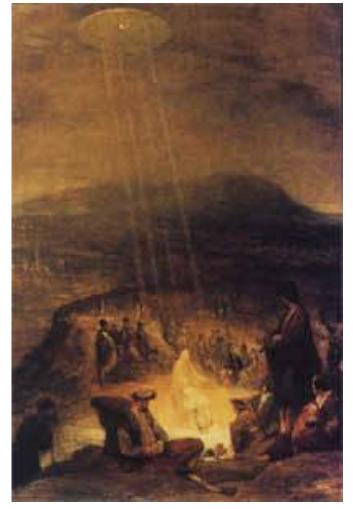
George Whitefield
I’ve been reading a biography of George Whitefield. He was an 18th century preacher whose ministry was integral in launching what is often called “The Great Awakening” in both England and the American colonies.
Whitefield was so popular, such an outstanding preacher and such a phenomenon that he preached in parks and fields often to crowds of tens of thousands of people before electronic sound amplification. These aren’t simply tall tales. Whitefield was a friend of Benjamin Franklin, a famous religious skeptic who personally witnessed and scientifically documented this phenomenon.
At that time in England and its colonies in the “New World” churches were mostly for the middle and upper classes. There were many poor communities where there were no churches. Whitefield felt called to minister to these communities and it was from these communities that huge crowds were drawn.
Whitefield’s Preaching
You might wonder what kind of preaching drew this kind of attention. Here’s an example of how Whitefield would use the elements to illustrate the messages he gave.
This hearer, describing one of Whitefield’s services in Boston, tells of the approach of a storm as the evangelist began his sermon. “See that emblem of human life,” he said as he pointed to a flitting shadow. “It passed for a moment and concealed the brightness of heaven from our view; but it is gone. And where will you be, my hearers, when your lives have passed away like that dark cloud? Oh, my dear friends .. . in a few days we shall all meet at the Judgement-Seat of Christ. We shall form part of that vast assemblage which will gather before His throne.”
Whitefield went on to plead with his hearers, directing his words to “false and hollow Christians,” then to “rich men,” and finally to the “sinner.” After urging, “Let not the fires of eternity be kindled against you!,” pointing to a flash of lightning he cried, “See there! It is a glance from the angry eye of Jehovah! Hark!” he continued, raising his finger in a listening attitude as the thunder broke in a tremendous crash, “It is the voice of the Almighty as He passed by in His anger!”
Dallimore, Arnold A. (2010-03-04). George Whitefield: God’s Anointed Servant in the Great Revival of the Eighteenth Century (Kindle Locations 1371-1379). Crossway. Kindle Edition.
Some of you might hear this and say “oh yeah. I know about this. This is all of that ‘angry god’ stuff. These old preachers were spiritually abusive. They’d scare people into religion as a means of control and a way to get money out of people.”
Who is God and what God wants Today
The whole fear and manipulation card is easy to produce, but times have changed. It isn’t hard to imagine a preacher like Whitefield wouldn’t be well received today partly because we can see who is well received today. Just google “Joel Osteen Quotes” and you can see the sea change.
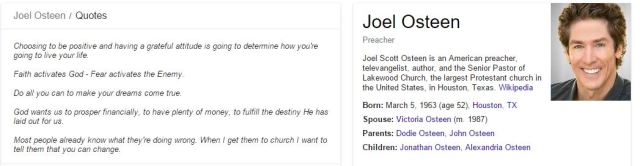
David Brooks finds Osteen in sync with the broader culture.
The shift can even be seen in the words that flow from the pulpit. Joel Osteen, one of the most popular megachurch leaders today, writes from Houston, Texas. “God didn’t create you to be average,” Osteen says in his book Become a Better You. “You were made to excel. You were made to leave a mark on this generation…. Start [believing] ‘I’ve been chosen, set apart, destined to live in victory.’
Brooks, David (2015-04-14). The Road to Character (p. 8). Random House Publishing Group. Kindle Edition.
This is basically in keeping with the rise of “spirituality” in the culture.
As I looked around the popular culture I kept finding the same messages everywhere: You are special. Trust yourself. Be true to yourself. Movies from Pixar and Disney are constantly telling children how wonderful they are. Commencement speeches are larded with the same clichés: Follow your passion. Don’t accept limits. Chart your own course. You have a responsibility to do great things because you are so great. This is the gospel of self-trust.
As Ellen DeGeneres put it in a 2009 commencement address, “My advice to you is to be true to yourself and everything will be fine.” Celebrity chef Mario Batali advised graduates to follow “your own truth, expressed consistently by you.” Anna Quindlen urged another audience to have the courage to “honor your character, your intellect, your inclinations, and, yes, your soul by listening to its clean clear voice instead of following the muddied messages of a timid world.”
In her mega-selling book Eat, Pray, Love (I am the only man ever to finish this book), Elizabeth Gilbert wrote that God manifests himself through “my own voice from within my own self…. God dwells within you as you yourself, exactly the way you are.”
Brooks, David (2015-04-14). The Road to Character (p. 7). Random House Publishing Group. Kindle Edition.
Gaining Broader Data
Now right away lots of questions arise. Who is God? How could we know him?
Right now in our cultural time and space our public way of dealing with these questions is skepticism. “Who’s to say who God is or what God wants?”
ISIS certainly has their ideas of who God is and what he wants. Jews do too. All of these religions make claims. What happened in Western history after the Protestant Reformation when Europe was tearing itself up over matters of religious doctrine democracy and a secular government were explored as solutions to political and religious violence. This was foundational in the American experiment that we are over 200 years into, but that doesn’t really help with the questions.
Imagining that the realm of the gods and the afterlife were dangerous and hazardous places was common and nearly universal in the ancient world. Egyptian monarchs didn’t build elaborate tombs equipped with boats, servants, furniture and food for nothing. You put coins on the eyes of dead persons because you needed money to “pay the boatman” in Greek mythology. Animists living in jungles all over the world had complicated rites and rules about living so as to steer clear of evil spirits that could threaten one’s family and future. Indigenous Meso-Americans had human sacrifices to keep the universe from sliding into destruction.
I think if an ancient were to come around today and look at all the fascination with “spirituality” they would likely look at us like we look at 19th century persons who played with radium, cocaine and mercury for entertainment. They’d look at us and say “you play with this stuff?”
Part of why Christian evangelism has traditionally worked so powerfully among animistic peoples was because what they looked for in Jesus wasn’t simply inspiration or a moral example, they looked for power for deliverance from spiritual forces.
Where Has All the Hazard Gone?
While there’s more concern for spiritual hazard at the class level of “folk religion” even in the secular cultures today in public society this is all dismissed as “superstition”. How has this developed?
Charles Taylor, a Canadian philosopher/sociologist talks about “the buffered self”. After about 1500 in wealthier, educated segments of society people began to no longer believe that the “spiritual world” impinged on daily life. Instead they saw the world in more scientific, mechanistic terms. If you child is sick you look at the chemistry in that child’s body and environment. You don’t suspect your neighbor has put “the evil eye” on your child and is trying to steal their soul.
You require that your doctor be a scientist and while you might ask for prayer in church your pastor would advise you to seek competent medical care.
The “buffered-self” is no longer vulnerable to spiritual hazards. The clouds and lightening in George Whitefield’s sermon are just water vapor and electricity and the angry god is dismissed as projections of sociological and cultural factors.
Where does that leave “spirituality”? Well we find it a useful psychological tool to help us feel better and to find meaning in our lives.
Big Questions Left Unaddressed
What we see while folks go about their business is a pretty shoddy approach to some very large questions.
- Are the materialists right that death is just the big sleep. That impacts how you live your life.
- Are the ones who declare the afterlife is hazardous correct. If so, what then?
- Are the happy spiritualists right? If so, no worries I suppose.
- Are the skeptics right in that you can’t know. Won’t this simply leave you anxious?
Jesus’ Baptism
Having asked all of these questions, we might now look at our text for this week. Just two little verses out of the Gospel of Luke.
Luke 3:21–22 (NET)
21 Now when all the people were baptized, Jesus also was baptized. And while he was praying, the heavens opened, 22 and the Holy Spirit descended on him in bodily form like a dove. And a voice came from heaven, “You are my one dear Son; in you I take great delight.”
Why are these verses here? What is so important about them?
The Baptism of Jesus is an important, but brief story in all four gospels. Even very skeptical scholars of the biblical gospels see this event as historical and the accounts straight forward. Now they might not imagine the voice from heaven to be historical, but that Jesus was baptized isn’t doubted.
It seems clear to me, however, that the event was recorded for the impact of exactly the issues we face today. How can these large questions be answered? The text asserts nothing less than “God” as understood by the Jews as the creator of the world and the God over all the world described Jesus as his son and affirmed him. This of course becomes the basis for Christianity, the Christian understanding of the Trinity, and how we are to know God.
Does this Settle Anything?
One thing I have noticed about people is that what convinces us is often personal experience. This isn’t new either. Wasn’t it Thomas who wouldn’t believe his fellow disciples that Jesus has rose from the dead unless he placed his fingers in the nail wounds and hand in Jesus’ side? Are we much different? Something often happens to people so that they believe, but often it is a combination of an event or a relationship in their life in combination with their cultural context.
Over the last few weeks we’ve talked a bit about John the Baptist. We saw what kind of preaching he did. He preached what he did within a cultural context. The Jews awaited the return of the LORD or his messianic servant who would reverse their political, economic and cultural misfortunes. We know the Romans and the Greeks assumed that their power was maintained by sacrifices to the gods. Neither of those context had “the buffered self” like we have today. They all imagined that God or the gods ruled the earth and determined humanity’s destiny.
When the heavens open, God speaks and the dove comes down everyone in that context would understand the message clearly. This Jesus has power and divine sanction.
Surprise Number One
Now the ancients assumed spiritual hazard, and we post-moderns presupposed a spiritual Disneyland, but what we find in this encounter and with Jesus is remarkably different from both blanket assumptions.
Jesus brings messages both of God’s favor and divine hazard.
On one hand it is Jesus who is eloquent about the generous character of God. He makes the rain to fall on the just and the unjust and Jesus calls this “perfection” (Matthew 6).
Jesus encourages his followers to pray as to a gracious father who won’t give a scorpion or a snake when their child asks for fish or an egg. This is the picture of a generous God who is committed to our welfare and understands our plight.
At the same time no one talks about divine judgment or wrath more than Jesus. God is also seen as the unsleeping defender of the innocent and judge over all our conduct.
The God Jesus articulates is both hazardous and generous.
Surprise Number Two
If we look a the fact of this divine manifestation we might wonder about the timing. Jesus did plenty of travel. Jesus would go to the temple, be arrested, tried, etc. Certainly God could have parted the heavens on one of these occasions resulting in the kinds of outcome we would wish for Jesus. What if the priests saw the dove and heard the voice? What if Pilate had seen this manifestation? Surely they all would be convinced that Jesus is God’s definitive representations. Surely they would have then obeyed his words and then with everyone believing in the right things then the world would be set right!
First let me note that all of the gospels describe this event as public. Jesus might have picked up a few follows but we have no indication that suddenly lots of people followed him, including John the Baptist who was right there. John continued on his normal path.
We imagine we are these rational creatures that if we somehow have the right revelation THEN we will reform our lives, all do this together and the world will be fine. We clearly don’t understand people even though we ARE people.
Revelation in Baptism
Baptism wasn’t simple a religious ceremony or an occasion for Jesus to have an audience in order to have this divine manifestation seen and Jesus’ divine credentials stamped.
Baptism as a ceremony has two major interpretations. The first is washing. Baptism is a ceremonial washing where we imagine sins and impurities are washed away.
The second interpretation is that of spiritual trial or ordeal. It is similar to the Nebuchadnezzar’s fiery furnace or Daniel’s lion’s den in the book of Daniel. It is an ordeal by water where divine judgment is tested and manifest by extraordinary means. It is no accident that it is in this context that the divine approval of Jesus is publicly manifest because it anticipates Jesus major ordeal, ordeal by crucifixion and death where He will be fully tested but in that case without clouds parting and dove descending. On that day the clouds will roll in, the sun will be blotted out and Jesus will be abandoned to suffer and in the eyes of the observers to lose the test. In that ordeal he will not be spared from death but instead become its victim.
Misery
The great switch in the imaginary from Whitefield’s and the ancient’s divine hazard to the contemporary divine Disneyland reflects the stage upon which we imagine our truest selves occupy. Surely what God cares most about is whether I’m feeling good about myself, having my best self now and making today a great day!
Jesus’ message is that we are not in control of our natures but are its victim. It doesn’t matter how divinely sanctions rules and tips might be we are incapable of securing our own release from our own prisons. Neither our skepticism nor certainty about a particular path can bring us across the line to having our dreams come true. We are that lost.
It is in trial that revelation comes and we finally see the need for a savior. It is in the end our our abilities that we begin to see our need for God’s intervention on our behalf.
Deliverance
The two events that the most skeptical New Testament scholars feel comfortable embracing as historical are Jesus’ baptism and crucifixion. These two events must come together for either to fully make sense. Jesus is God’s own Son, beloved, approved, embraced. In the ceremonial waters of ordeal God vouches for Jesus and his public ministry begins.
In the non-ceremonial ordeal of the cross the clouds do not part, and God forsakes Jesus, and author of creation becomes hell’s victim. That is the second moment of authentic revelation. It is revelation of our crimes, revelation of God’s commitment, revelation of Jesus’ love.
The third manifestation will of course be the resurrection. THAT will be the manifestation that begins to work in our minds in ways the parting clouds and the dove did not accomplish. After that Ascension and Pentecost happen and the pieces begin to fall together.
Gratitude
While we are given Jesus’ divine credentials accepting them as something apart from ourselves is insufficient. We must enter the drama. We must see our inability to appropriate some list of rules or practices as sufficient to make ourselves the authors of our rescue. We must rely on the rescue made for us.
Our response then is gratitude. We cannot add to what he has achieved, but we can follow in his train.
It is actually, most often, in our ordeals that the revelation begins to grab hold. It isn’t until we experience our failure in the context of his actions that we stop indulging in the illusions of our power and control and start accepting and following in his power and mercy. This is the start of the Christian life.


 Leadingchurch.com
Pingback: When Jim Carry Exposed Our Despairing Story-Verse and how Jesus as Hidden Wine Maker Invites us To Believe a Better Story | Leadingchurch.com