
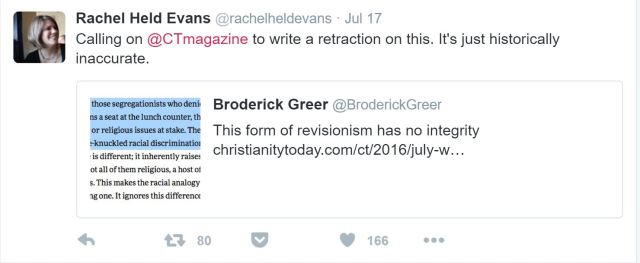
CT: Christians don’t want to stop serving their LGBTQ neighbors
Consider the irony when this complicity shoe is on the other foot. Last year Canadian mediareported the case of a gay couple requesting their money back from the jeweler who had made their wedding rings. The couple had liked the rings and the service they received, and they recommended the jeweler to their friends. But when they later discovered that the jeweler did not support gay marriage—he had posted a sign in his store that read, “The sanctity of marriage is under attack. Let’s keep marriage between a man and a woman”—the couple sought a refund. They didn’t want anyone with convictions such as this jeweler’s, they said, to have anything to do with their wedding.
The problem here was obviously the issue of complicity. The jeweler had in no way discriminated against the couple. “They were great to work with,” said the couple. The jeweler’s only sin was his moral conscience. While rainbow flags flew up and down the street in other businesses, the one small sign hanging on the wall of the jeweler’s shop was his undoing. He lost business and was trashed on social media. “I had to shut down the Facebook page,” he said, “because of so many hate emails and phone calls and just really nasty stuff.”
So here is the irony: For discriminating against the jeweler, based solely on his moral convictions, the gay couple was valorized, while the jeweler was punished. But conversely, had the jeweler refused to participate in their wedding due to those same convictions, the gay couple would still have been valorized and the jeweler trashed. Heads I win, tails you lose. This is the very definition of injustice. The only good thing that can be said about this episode is that the gay couple obviously understood the principle about even the jeweler being “complicit” in their wedding.


 Leadingchurch.com
Framing? Litfin’s view can be summarized as “of course not, trust us.” This question of how far general society should trust the Evangelical is another of the issues. We might call this the Rod Dreher problem: culturally, some evangelicals are very much part of the broader liberal society; they get it; but convictionally they stand apart. From the outside, the question arises, ‘well, which is it?’ and so the notion of bad faith creeps in.
A large part of this has to do with the confusion of evangelical convictions and Evangelical as a social group. Liftin wants to go with the convictions but distance himself from the social group; you can identify this as a social or class division. Yet follow his argument, over and over he cannot find the room for the other side, but simply assumes the Evangelical side (so on the abortion section: women’s health, yes, but what about the fetus — and women’s health disappears, with never so much as a cocked-eyebrow that maybe the women’s health issue is pertinent; it’s denied).
So let’s look at the options. First, the Evangelical position, whatever it is, is a dead end. Reason: the term simply defines a sociological class, the sunbelt middle class at prayer, if you will. So, any framing of any position as Evangelical is doomed, being hitched to the dead weight of culture. Second, that frees up congregations and preachers to present evangelical truths, but with new language. The development of this new language is one, perhaps the primary task for church planters; the settled church needs new language for its convictions, and the missional church is the one developing it.