
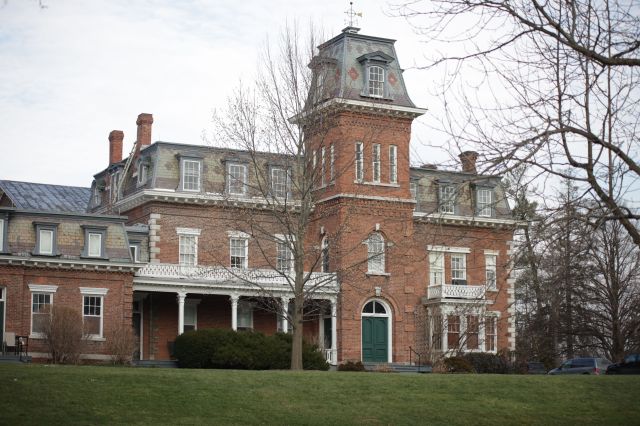
Prompted by that New Yorker piece on the Utopians I picked up a book on the Oneida community written by a descendant if its founder. https://www.amazon.com/Oneida-Free-Utopia-Well-Set-Table-ebook/dp/B0140PFNVQ
It is a fascinating read on many levels. The “burned over district” produced some of the most formative American Christian heretical communities we’ve got. This community was no exception.
What interests me is this pre-Civil War quest to remake the social fabric in some pretty dramatic and radical ways, not unlike the kind of foment we see happening today. A different then of course was that there was less appetite for it in the broader sphere but a sort of frontier freedom available to these groups.
Of interest to me in this one particular chapter was alignment in the popular imagination between abolition of African American slavery and abolition of female slavery in marriage. There were many attempts to address this in very different ways. The Oneida community is famous for their “complex marriage” which was an attempt to manage both the chaos of sexual desire and the “bondage” of women to reproductive hazard and burdens due to child rearing. Even though they were hierarchical in their “Bible Communism” seeing Noyes, their founder and leader as God’s instrument in this new revelation of the new age the community in its early days afforded a great deal of opportunity that we would identify as equality for women, far more than women would likely find in other places in middle 19th Century American society.
Living at Oneida was not, then, a libertine free-for-all; it meant, on the contrary, subjecting oneself to a strict regimen of introspection and self-restraint to ensure the continual, even circulation of love and of God’s magnetism throughout the body of the whole organism. At the end of his “Bible Argument Defining the Relations of the Sexes in the Kingdom of Heaven,” Noyes appends a nota bene, aimed directly at Fourierists and free lovers alike, limiting Oneida’s liability in the case of a gross misapplication of their theory: “Holiness must go before free love. Bible Communists are not responsible for the proceedings of those who meddle with the sexual question, before they have laid the foundation of true faith and union with God.” 23
And yet for all its severity and its biblical defense of women’s natural inferiority, Oneida proved itself a practical workshop for gender equality in ways undreamed of by actual feminists of the period. Its female members enjoyed a range of professional, emotional, and sexual and reproductive freedoms that would have shocked even the most ardent leaders of the nineteenth-century women’s rights movement. If Noyes used scripture to confirm the spiritual inferiority of women, his quest to reform the perverted relation between the sexes that had reigned on earth ever since the expulsion from the Garden of Eden led to a series of practices that effectually liberated Oneida women from many of the strictures under which their nineteenth-century sisters in the outside world continued to labor.
Wayland-Smith, Ellen. Oneida: From Free Love Utopia to the Well-Set Table (pp. 71-72). Picador. Kindle Edition.
Nor was Oneida’s desegregation of sex-specific work restricted to manual labor. The Community ruled itself by ad hoc appointed committees, which were generally staffed with both men and women. Women could be journalists, editors, typesetters, bookkeepers: they had an active voice in the day-to-day intellectual, practical, and political life of the Community largely denied their sisters in the outside world. One young woman, as reported in the in-house news bulletin, “has commenced taking lessons in dentistry, with a view to qualifying herself for service in that department.” Before joining the Community, my great-great-grandmother Emily Otis expressed her desire to work in the print shop there, noting that such employment was not generally considered appropriate for women: “Father tells me that I ought to be doing something to earn my living; I told him I would like to be a typesetter but I did not expect to go out in the world and do it, as the world is now.” 30
If Noyes believed women were, spiritually speaking, naturally inferior to men, they could nonetheless give men a run for their money in the intellectual sphere. Tirzah Miller, John Humphrey Noyes’s niece, took over editing The Circular from her aunt Harriet Skinner in 1869, the second woman to fill the post. Her uncle’s hopes were pinned on her to turn The Circular into a mouthpiece for Bible Communism, just as the Boston transcendentalists had launched The Dial several years earlier to disseminate their new brand of pantheistic philosophy. The Dial had appointed several women to its team, including feminist Margaret Fuller as editor and Nathaniel Hawthorne’s sister-in-law, Elizabeth Peabody, as business manager. Noyes abhorred the likes of Fuller, Hawthorne, and Ralph Waldo Emerson, “these Boston and German writers [who] try to influence readers with their atheism and hatred of revivals.” He intended Tirzah to hone her critical skills until she could rival the transcendentalist mantra: “You must get so you can criticize Miss Peabody first. You can make a better critic than Margaret Fuller, or Miss Peabody, or Miss Q-body,” Noyes coaxed his niece. In a world where work, by the middle of the nineteenth century, was being increasingly codified into a feminine “domestic sphere” and masculine public sphere, Oneida women could thus set type or hoe fields, bake bread or split logs, study Greek or write literary criticism pretty much as they chose. 31
Wayland-Smith, Ellen. Oneida: From Free Love Utopia to the Well-Set Table (pp. 76-77). Picador. Kindle Edition.
Noyes teaching was an interesting mix of quasi science (“God’s magnetism), millenial and utopian social experimentation and semi-monastic discipline to create their community and try to resolve the questions the age was struggling with.
Noyes was of course not alone in these struggles but his approach was different from that of some of the mainline abolitionist-women’s liberationist pioneers especially on the question if individualism
At first glance, Oneida’s sexual program as outlined in the “Bible Argument” would appear to square with many of the same sentiments animating the larger public discussion of the marriage question circa 1850. Like Stanton and Nichols, the Oneida Community also weighed in decisively on the perverting properties of marriage by comparing it to chattel slavery, printing a pamphlet entitled “Slavery and Marriage: A Dialogue” in 1850. While the Oneidans were naturally sympathetic to the antislavery cause, they felt the abolitionists’ exclusive focus on the evils of America’s peculiar institution left untouched the more pervasive social, economic, and sexual ills plaguing the nation. Noyes’s “Dialogue” begins by presenting a heated argument between “Judge North” and “Major South” on the morality of slavery, in which Judge North’s enlightened opinions clearly carry the day over Major South’s attempts to bolster slavery by reference to the Bible, natural law, social order, and the supposed happiness of the slaves themselves. At this point the mediator, “Mr. FreeChurch,” enters the fray and asserts that the institution of marriage is open to all the same charges that Judge North has just laid at the feet of slavery: marriage is as “contrary to natural liberty” as slavery is. Just as the slave is denied access to literacy and the Bible, so marriage locks women into following the conscience of their husbands instead of finding God for themselves. To Judge North’s protest that licentious anarchy would be the result of abolishing marriage, Mr. FreeChurch responds evenly that “liberty breeds virtue” and that “free-love, or complex marriage, combined with community of property, would annihilate the very sources of adultery, whoredom, and all sexual abuse.” Sexual poverty and forced abstinence, so common under the marriage system, were the true causes of sexual license; “the feeling of plenty would directly stimulate to chastity and self-control.” 17
Despite making use of the same slavery-marriage analogy that had fueled the arguments of Stanton and Nichols, Noyes’s pamphlet was far from a feminist battle cry. True feminist claims, like the abolitionist arguments they modeled themselves on, borrowed from the language of contract law to assert each individual’s right to “self-ownership” within contractual relationships. Worker-employer relationships and marriages that eliminated one party’s freedom to contract or dispossessed one party of self-ownership were declared null and void. But Noyes, unlike Stanton, cared little for women’s legal and financial subjection to men. Rather, Noyes’s sympathies clearly lay with Mr. FreeChurch’s when the latter asserted that in the new order women and children would no longer be financially dependent on one man but would be secured protection “by a responsible association of men,” a tacit endorsement of the dependent status of women. And unlike Nichols, Noyes was blatantly uninterested in free love as a way to liberate women’s desires and bodies from masculine control. Noyes essentially agreed with the apostle Paul when he declared, in his letter to the Corinthians, that “the head of every man is Christ; and the head of the woman is the man” (1 Corinthians 11: 3). The sole justification for the practice of multiple sexual partners was that it released the free flow of sexual energy, both male and female, that had to be communized in order to re-create God’s kingdom on earth as it is in heaven. Free love as a guarantee that a woman could bestow her affections following her individual inclinations— as Nichols so ardently wished— was, in fact, the last thing on Noyes’s mind. 18
Wayland-Smith, Ellen. Oneida: From Free Love Utopia to the Well-Set Table (pp. 68-69). Picador. Kindle Edition.
You can see how the elements of the American culture amalgam of equality and individualism and communitarianism mix in different ways within the context of both mainline and heretical-sectarian Christianity. Fascinating stuff that seems quite interesting given today’s conversation. pvk


 Leadingchurch.com