
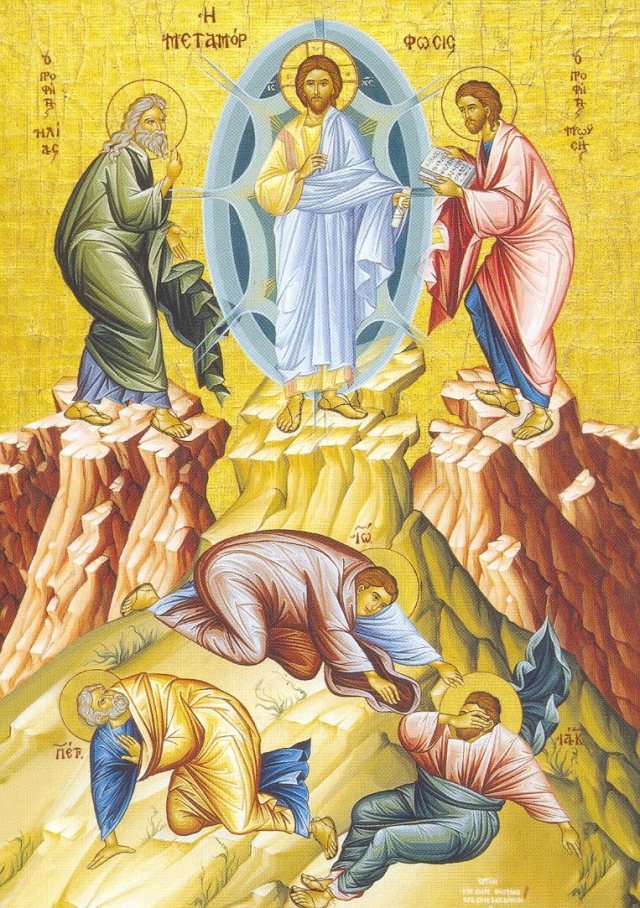
I’m back in the lectionary this week and the text of the Transfiguration is next.
This is a VERY big deal in the Orthodox tradition, less so in the West.
The transfiguration story has had an especially intensive influence in the Greek and Russian church. It is closely identified with the Feast of Metamorphosis that has been celebrated in the East since the sixth century and is among the twelve great church festivals.52 The most important witnesses of the history of our text’s influence are the festival sermons of the Metamorphosis and, along with them, the theme’s artistic representations in icons, murals, and pictures.54 Onasch is of the opinion that the “transfiguration” has something of the same central meaning for the Eastern church that the idea of justification has for the West. However, “transfiguration” means not our story, Matt 17:1–13*, but the mystical and hope-filled participation of the believers in the reality of Christ’s resurrection, precisely what our story symbolizes. The sermons and icons are important, because they are able to incorporate both levels which were fundamental for the Matthean story—the christological level of the revelation of the glory of Christ and the level of the disciples who share in the power of the metamorphosis. By looking at the history of the text’s influence we will see that only when both levels are related to each other—only when the readers of this text let Jesus lead them to the mountain and again back down from the mountain does an understanding become possible which is appropriate to the text itself.
Luz, U. (2001). Matthew: a commentary. (H. Koester, Ed.) (pp. 400–401). Minneapolis, MN: Augsburg.
I’m re-reading Neil Postman’s “Amusing Ourselves to Death”. I didn’t intend for this to inform the transfiguration but as a preacher I always want to keep myself open to providence.
To explain how this happens—how the bias of a medium sits heavy, felt but unseen, over a culture—I offer three cases of truth-telling.The first is drawn from a tribe in western Africa that has no writing system but whose rich oral tradition has given form to its ideas of civil law.4 When a dispute arises, the complainants come before the chief of the tribe and state their grievances. With no written law to guide him, the task of the chief is to search through his vast repertoire of proverbs and sayings to find one that suits the situation and is equally satisfying to both complainants. That accomplished, all parties are agreed that justice has been done, that the truth has been served. You will recognize, of course, that this was largely the method of Jesus and other Biblical figures who, living in an essentially oral culture, drew upon all of the resources of speech, including mnemonic devices, formulaic expressions and parables, as a means of discovering and revealing truth. As Walter Ong points out, in oral cultures proverbs and sayings are not occasional devices: “They are incessant. They form the substance of thought itself. Thought in any extended form is impossible without them, for it consists in them.” 5To people like ourselves any reliance on proverbs and sayings is reserved largely for resolving disputes among or with children. “Possession is nine-tenths of the law.” “First come, first served.” “Haste makes waste.” These are forms of speech we pull out in small crises with our young but would think ridiculous to produce in a courtroom where “serious” matters are to be decided. Can you imagine a bailiff asking a jury if it has reached a decision and receiving the reply that “to err is human but to forgive is divine”? Or even better, “Let us render unto Caesar that which is Caesar’s and to God that which is God’s”? For the briefest moment, the judge might be charmed but if a “serious” language form is not immediately forthcoming, the jury may end up with a longer sentence than most guilty defendants.Postman, Neil. Amusing Ourselves to Death: Public Discourse in the Age of Show Business (Kindle Locations 494-511). Penguin Publishing Group. Kindle Edition.
The answer he received took the following line: You are mistaken in believing that the form in which an idea is conveyed is irrelevant to its truth. In the academic world, the published word is invested with greater prestige and authenticity than the spoken word. What people say is assumed to be more casually uttered than what they write. The written word is assumed to have been reflected upon and revised by its author, reviewed by authorities and editors. It is easier to verify or refute, and it is invested with an impersonal and objective character, which is why, no doubt, you have referred to yourself in your thesis as “the investigator” and not by your name; that is to say, the written word is, by its nature, addressed to the world, not an individual. The written word endures, the spoken word disappears ; and that is why writing is closer to the truth than speaking. Moreover, we are sure you would prefer that this commission produce a written statement that you have passed your examination (should you do so) than for us merely to tell you that you have, and leave it at that. Our written statement would represent the “truth.” Our oral agreement would be only a rumor.The candidate wisely said no more on the matter except to indicate that he would make whatever changes the commission suggested and that he profoundly wished that should he pass the “oral,” a written document would attest to that fact. He did pass, and in time the proper words were written.Postman, Neil. Amusing Ourselves to Death: Public Discourse in the Age of Show Business (Kindle Locations 537-548). Penguin Publishing Group. Kindle Edition.


 Leadingchurch.com