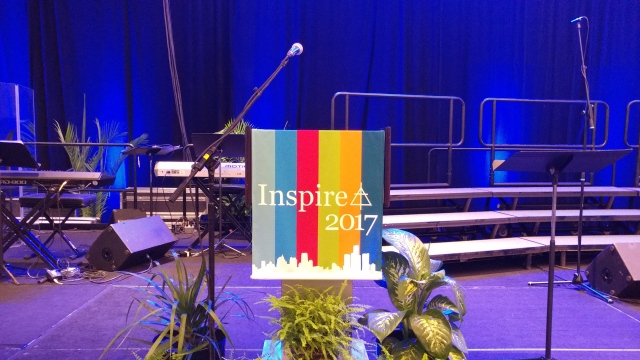
At breakfast a woman expressed her disappointment to me at Inspire2017 about there not being an LGBT Breakout. How and where can the CRC facilitate difficult yet consequential conversations?

2017-08-04 10.15.53Breakfast conversation

For me the most important part of almost any gathering are the unplanned conversations. Conversations like these are an invaluable way to get a sense of what is afoot in the church and what people are thinking. So at breakfast one morning a Canadian woman who was retired from a subculture high status position told me about an expectation and hope she had for the Inspire conference. She told me that she had hoped they would have had a breakout group on the CRC and the LGBT question. She had apparently contacted someone and asked if the conference would host such a conversation and the answer was no. It wasn’t the purpose of the conference to get into an issue like this. She was disappointed but accepted the explanation and understood it.

Why no LGBTQ Breakout Group for Inspire2017?

On one hand if I were in charge of the conference I would likely have made the same decision. I can appreciate the reason to not get into it. On the other hand a decision like this says a lot about where the denomination is at. If you want to know where the unresolved stuff is in a relationship or community go to the things not talked about.

I decided to probe a bit more.

I suggested that hosting a conversation about this issue is a pretty complicated thing to do well. There was another pastor at the table who was new to me, and so he chimed in and agreed with me. In the church context this is a notoriously difficult conversation especially if you are responsible for an institution (like a local church) and have an eye out for outcomes. This issue always has with it the potential of alienating someone and even driving them from the church no matter what way the conversation goes. For most stewards of an institution such a conversation is potentially high risk, low reward.

She testified that this was a big issue in the churches where she lived and that she’d like more conversation about it. She didn’t state her position to me although I assume she had one even if I didn’t presume to know what it was. In other words I didn’t get the sense that she was looking for an answer as much as looking for a resolution to the conflict along the lines of her desired outcome.

Should the denomination posture itself like it did with WICO?

I decided to go a bit deeper with this with her. I asked her what posture the denomination should take in hosting such a converation. Should the denomination act as an impartial host for the conversation or should the denomination promote its current position on the subject?

This question gave her pause. She clearly had an assumption about it but had never thought about this aspect of the conversation. After a moments thought she decided that the denomination should play the part of an impartial host, as it did, in her words in the women in office (WICO) controversy.

I decided to probe this a bit with her too so I asked her if she thought the way the CRC pursued that conflict brought resolution or prolonged the conflict leaving it unresolved and even perhaps unresolvable. I noted that it is common for neither side in that debate to feel completely comfortable with the denominational “2 voice” position. Those against WICO sometimes profess to feel like an unwelcome minority in some settings while many women also feel themselves disadvantaged by hidden biases leaving them also feeling like second class citizens. I asked if she thought how we handled that actually and finally resolved anything?

At this point I think I exhausted her interest in this line of conversation at the breakfast table and we let it rest there.

Takeaways

To me a conversation like this is important data. This was obviously a very loyal CRC member. She was very well educated, articulate and concerned about the future of the CRC and this topic. It leaves me with all the same questions I’ve been stewing for a long time.

  • How should leadership work in the CRC? How should CRC institutions facilitate leadership? What kinds of leadership do we need and what are our expectations about it? These are not simple issues given the complex relationship between the CRC as organism and the denomination as sy-board.
  • What did this conversation say about our implicit lists of in and out-of-bounds. I doubt she would have thought the CRC should host a conversation on polygamy or legalizing prostitution. There are some subjects that people imagine are “up for debate” meaning open for consideration and acceptance while others are not. So what really are these conversations for?
  • How do we have these conversations? I’ve said for a long time that we have a poor track record in facilitating large, consequential, long term conversations and my exhibit A has been the Belhar conversation. If anyone thinks we are done with it you’re mistaken.

I think the idea of establishing a category of “contemporary testimony” is a good move in hopes of facilitation future conversations but I haven’t seen any evidence that we’re taking steps to figure out how to do this moving forward. What this tends to mean in my experience is that we will continue to not do conversation well.

I believe that the overture/synod process is a good one but it tends to be rather binary. We’ve tried to do something different with the “Faith formation” process and for that effort I think we’ve seen good results, but part of that was the nature of that particular pursuit. No one is going to be against improving how we remember our baptism and facilitating profession of faith and beyond within our confessional position.

No LGBTQ but there were plenty of Social Justice Breakouts

I did notice that there were numerous breakout groups that touched on what is currently being called “social justice”. As we saw at Synod 2017 this is another hot button area for many in the CRC. Matt Tuininga, who teaches Moral Theology at CTS recently wrote a “The CRC Needs a Conversation on the Gospel and Social Justice”. Robert Joustra who teaches at Redeemer had a piece on The Banner website.

I love the fact that the Inspire conference has created a new space for the body work we need to do ministry in this globalized culture but we haven’t seemed to figure out how to have other conversations as noted by the increasingly volcanic polarization around social justice issues.

So, what do you think?

  • What does the CRC need to do to figure out how to institutionalize leadership?
  • How do confessions relate to contextual change and how can that help guide us in posturing denominational resourcing for processing conflict?
  • What next steps do we need to take to figure out how to have better, larger conversations about controversial and consequential issues?
Posted in CRC | Tagged , | 2 Comments

The Misadventure of Light-Skinned Lexi

http://everydayfeminism.com/2017/08/the-misadventures-of-light-skinned-lexi/

Posted in Daily Links and Notes | Leave a comment

Peter Enns 5 Challenges to Staying Christian

https://www.peteenns.com/5-challenges-staying-christian/

https://www.peteenns.com/8-thoughts-staying-christian-anyway/

Posted in Daily Links and Notes | Leave a comment

Christian Beaty on Why Christians Should Avoid Watching Rape Scenes

http://www.christianitytoday.com/women/2017/august/why-christians-should-avoid-watching-rape-scenes.html

Posted in Daily Links and Notes | Leave a comment

Polygamy gets a big perceptual upgrade in USA since 2003

http://religionnews.com/2017/08/01/polygamys-becoming-more-acceptable-is-this-the-sister-wives-effect/

Posted in Daily Links and Notes | Leave a comment

How I went from cynical-skeptic to enthusiast about #CRCInspire2017

2017-08-04 09.55.01

Chris Meeham the CRC communications writer after reading this posting wanted a few quotes. Coming up with quotes is hard so I wrote a narrative from which he could quote. Here’s the note I wrote to him.

I was skeptical of this endeavor at first. I didn’t know about its genesis (a couple of people approached me and said basically it was the idea of such and such a person or such and such a classis or organization or effort) but I wondered “well who will go to this thing. Certainly not me.”

How did I get there?

My friend Mark Hoffman, the pastor at Alameda told Paula Wigboldy that I absolutely must do a breakout group about the RLI effort. He started prompting me and then she started pestering me. I don’t know how many times I thought and said “no” to them for a host of reasons but Paula simply wouldn’t take “no” for an answer so i finally relented. Along the way I got roped into other things that I had second thoughts about and got passive-aggressive-resistant over but in the end I took the red-eye to Detroit and checked into the hotel a fairly determined cynic. I figured I would enjoy part of it for the reason I often enjoy going to Synod, it gives me a chance to see old friends from college and seminary and to hang out in person with people I’ve met and related to online since online became an option. I was anticipating that kind of fun but the rest of it I was uncertain and hesitant about. I’m not a big conference goer because I figure I’d rather spend the few hundred dollars they cost on books and gadgets that fuel and facilitate my ongoing education. I don’t often find conferences for me a very helpful deployment system for learning or for community growth.

I didn’t know why we were meeting in Detroit. That reveals my lack of awareness about the geography of the CRC in Canada. When I got there I tried to take an immediate measure of who came, and the Canadian presence stood out. I thought “that’s pretty savvy having it here really if you want to strengthen binationality.”

I also began to notice how strong the African American community is in Detroit. I knew that theoretically but it became very obvious at the Renaissance center. I’m accustomed to traveling in the American west where most of the service staff is of Hispanic origin but the Detroit culture came though quickly. Having grown up at my father’s church where the African American great migration context governed (read Isabel Wilkerson’s great book Warmth of Other Suns ) I knew some of the culture complexity that this conference would have to have. This obviously played into the reflections in the personal history blog post. I remember Canadian students coming to Calvin College never having seen, much less personally known, an African American individual. Growing up in Paterson that completely shocked me. I grew up assuming that black Americans were the majority in the US because as a child so much of my small world was filled with them. Later of course I my perception was corrected by statistics but the CRC’s relationship with diversity is complex and often clumsy. I began to see the value of a conference that was multi-cultural without it being called multi-cultural. Once you promote that label you create a set of expectations that i think invites people into some alien third space from which they intend to retreat from upon returning home. In my life that third space has always been my home space, and it is equally true for me in Sacramento as it was in Paterson.

I began to appreciate the setup of Inspire as a sort of working laboratory for ministry without having to be too self-conscious about it. Breakout sessions were offered by ministry practitioners. The real benefit of the conference though I think is often the real benefit that Synod has offered CRC office bearers but now without the restriction of office holding towards membership in the temporary learning community. Part of the genius of it was the generalism. Once I was there I began wishing that many more of my friends and church members were there too. I began to see the value of a gathering that was really more convention than Synod. I’m not saying we should drop Synod or our specialty conferences, but the convention spirit could help the CRC do the real body work it needs to do to forge its new identity for a far more complicated and diverse world it is emerging into.

As I noted in my blog post I’ve been listening to a lot of Jordan Peterson and soaking up some Piaget. Scientists are increasingly aware that we act into theory more than we act out of it. The body comes first and the abstract conceptualization comes second. For this reason I think a generalist convention type even it pretty important for the CRC for the future. The speakers and the teaching things are important but secondary to the opportunity for body life that the event affords. Denominations are fundamentally apparatuses of trust. That’s what’s behind credentialing and branding and all the things we do that we don’t immediately associate with trust. So much CRC cohesiveness and covenantal faithfulness was built on that trust in the past was facilitated by so many communitarian signals like ethnicity or confessional fidelity. Now as we face a larger world where ethnicity and confessionality are more complicated we need to create spaces where we can practice trust before we conceptualize it, which is what made Inspire 2017 so helpful. It allows the CRC to do the body work necessary to facilitate the harder conversations we need to have to engage our complex larger world.

Posted in CRC | Tagged | Leave a comment

Could you write a movie about someone like Mike Pence?

http://www.theamericanconservative.com/dreher/judd-apatow-and-conservative-movies/

http://www.vulture.com/2017/08/judd-apatow-on-his-legacy-feminism-and-republicans.html 

Douthat: a Requiem for Girls 

The liberal mind suffers from this too. It is “conservative” in this sense: preferring comforting lies to messy reality.

Posted in Daily Links and Notes | Leave a comment

Jordan Peterson Maps of Meaning Lecture 1

This is the beginning of the course. Here is the text from the YouTube description.

In this lecture, I discuss the context within which the theory I am delineating through this course emerge: that of the cold war. What is belief? Why is it so important to people? Why will they fight to protect it? I propose that belief unites a culture’s expectations and desires with the actions of its people, and that the match between those two allows for cooperative action and maintains emotional stability. I suggest, further, that culture has a deep narrative structure, presenting the world as a forum for action, with characters representing the individual, the known, and the unknown — or the individual, culture and nature — or the individual, order and chaos.

Peterson was driven by his experience of the cold war to ask “what would lead people to the point of risking the annihilation of humanity through nuclear war?” He was then forced to ask “what is a belief?” He went from individual to community, etc.

Continue reading →

Posted in Daily Links and Notes, Quotations | Tagged | Leave a comment

5 Feminist Micro-Aggressions against Muslim Women

http://everydayfeminism.com/2017/08/microagressions-muslim-women/

Posted in Daily Links and Notes | Leave a comment

The One Where I Argue Against Tattoos

http://www.patheos.com/blogs/troublerofisrael/2017/08/the-one-where-i-argue-against-tattoos/

Posted in Daily Links and Notes | Leave a comment