

CRC RCA Joint Synod
The CRC-RCA Joint Resolution
Tonight in a joint session of Synod the CRCNA and the RCA passed this resolution.
Therefore, as the General Synod of the Reformed Church in America and the Synod of the Christian Reformed Church in North America, we declare that the principle that guides us, and the intention that motivates us, is to “act together in all matters except those in which deep differences of conviction compel [us] to act separately”; and, further, We jointly instruct the Board of Trustees of the Christian Reformed Church and the General Synod Council of the Reformed Church in America, in looking to the future relationship between our two denominations, to be guided by this principle.
I think to the shock of the officers a joint CRC-RCA pair attempted to amend the statement.
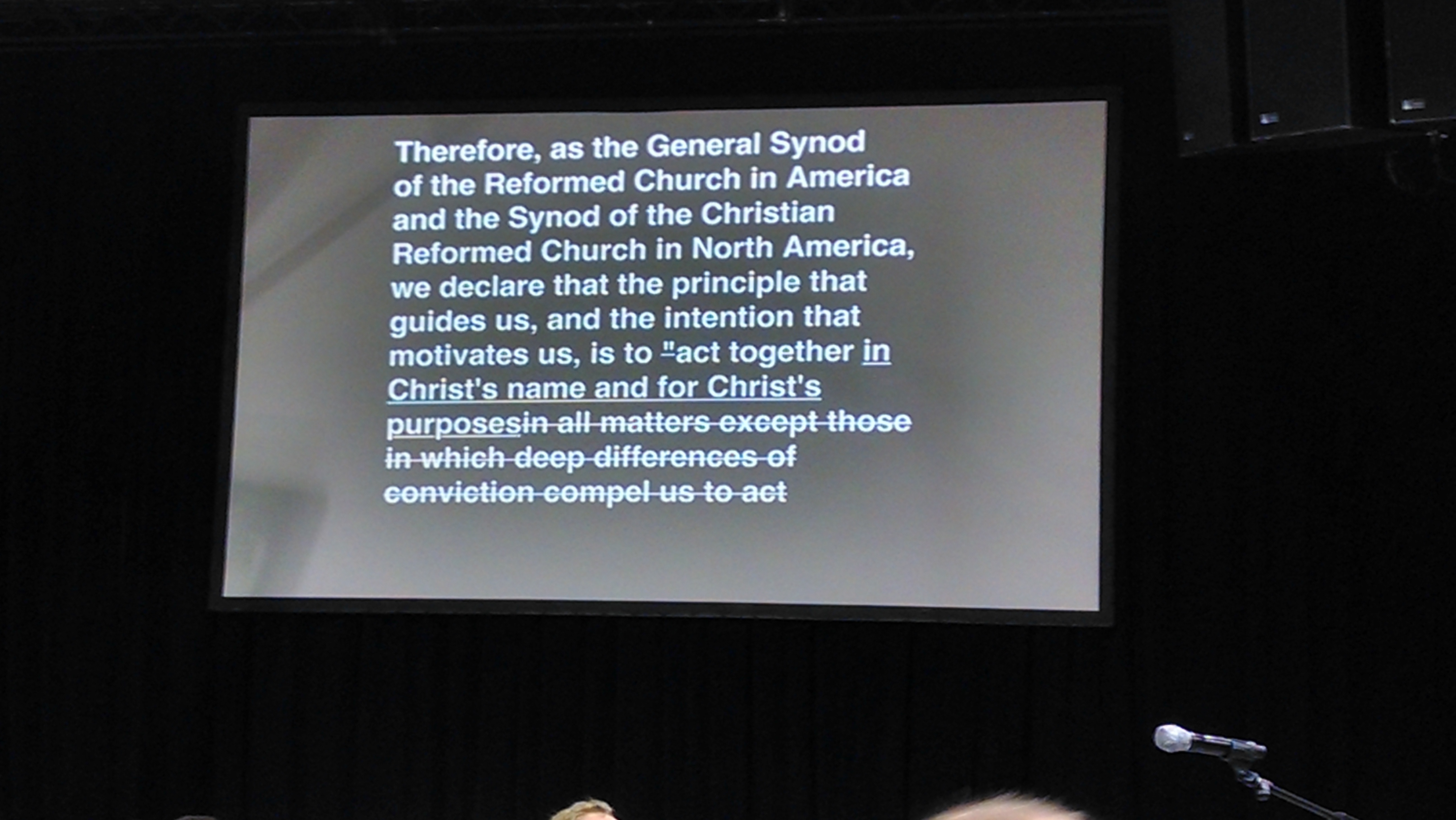
Failed Amendment
The statement in quotes was “The Lund Principle“.
The objection to the quote was that it was feared to give “a way out” of serious collaboration.
This quotation implies the opposite.
The question formulated at Lund inverts the typical denominational point of view. It subtly shifts the burden from a council of churches back to its member denominations to judge for themselves the sufficiency of their “eagerness” to “act together in all matters.” The Lund Principle presses on a council of churches and its denominational membership the contemplation of an entirely different perspective on the interrelationship between them because it calls them to confront the key question of how well they are living out the ecumenical vision of not only being together, but acting together. Does their being together enable them to be acting together?
Still, the difficulty with the Lund Principle lies not so much in the discipline it seeks to impose on both the member denominations and the council of churches to which they belong as it does with the way those party to any serious conversation about it are likely to respond, this is, to recoil instinctually in institutional horror from the uncompromising implications of it. A council of churches would be remiss in its duty if it failed occasionally to remind its member denominations of the Lund Principle, the radical demands it makes on them and the practical application it has for them. If the ecumenical movement can be said to have a conscience, surely the Lund Principle is it.
Table Discussion
For our joint sessions with the RCA we’ve been assigned tables with CRC and RCA delegates together. I’m at table 57. We had a guided question process to discuss the larger resolution found in the Agenda for Synod 265-266.
I’ve been bothered by the language of the Lund Principle in the resolution because I don’t know how serious we are about it. Tonight, it hit me harder. It seems the Lund Principle is quite effective at what it intends to do.
I noted to our table that there are no “deep differences of conviction” that separate the CRC from the RCA. There are “deep differences of conviction” within the two denominations but I am hard pressed to think of any between us. Daniel Meeter stood up and made the same point at the mike. Go ahead, if you can think of one post it in the comments.
The Vote Before the Vote
The CRC had a quicky AM session. We were going to run through the ballot for denominational boards. It’s a rather pro-forma exercise. Some of the delegates were still struggling to figure out how to use the computerized balloting system.
While we were at it. Up came a recommendation from an advisory committee. Hmm. That’s strange.
B. Recommendation
That synod adopt the Joint Resolution prepared for the CRC synod and the General Synod of the RCA.Grounds
a. This provides an overarching statement that will serve as a mutually supported agreement between the CRC and RCA.
b. Though this resolution is not intended to serve as groundwork for merger, it will serve as a guiding principle in the journey that longs for healing and reconciliation.
This kind of snuck up on me.
We had it in front of us, no discussion, unanimously passed. Interim ED Joel Boot then noted that we had just approved what we were going to approve this evening.
I commented to my tablemate: “160 years of history: pfft, just like that. no discussion. Hmmm. Do we know what we’re doing?”
“Not Intended To Serve As A Groundwork For Merger”
This is the key line of course that could make tonight the feel-good-meeting that it was.
Hey, I get this. I’ve been doing KEZ work for 3 years. There is a TON of good stuff we can do without talking merger, and if we did start talking merger 160 years of culture and detail would bog us down with innumerable and probably intractable spats and bickering. The CRC AND the RCA both have plenty to do on their own never mind start talking about “merger”.
One person noted that if you try to merge two denominations you usually wind up with three. That is totally believable. Apparently denominations are like the mythological hydra who grows two new heads when you cut one off.
What REALLY Divides the CRC and RCA?
That Lund Principle really started to gnaw at me tonight as I sat at my table.
What DOES really divide the CRC and RCA? “deep convictions?” Nothing so saintly. Fear of loss of control and loss of power. Isn’t this what we are usually fighting about in our own Synods?
We can do joint work at the agency and services level. We now share Faith Alive, World Renew, and Benefits. We can collaborate on church planting. There are union churches. Our local congregations can collaborate. All of this is fun. It’s low hanging fruit.
At what level CAN’T we merge? Classis and Synod. It’s at THAT level that we are terrified. We don’t want some other side loosening our fearful grasp on control for any number of reasons. We believe that as long as we hope to maintain even the tenuous grasp on power that we have in our denominational politics they maybe everything will be OK. Better the devil we know from our own denomination than the ones from the other that we don’t.
The source of this “deep conviction” within me is my sinful nature. There isn’t anything Christian about it. It reveals my lack of faith in Jesus and the strength of my faith in myself.
So How Should I Vote?
So there I sat. Should I stand up to speak against the motion, be the turd in the ecumenical synodical punch bowl? Should I stand up and say “are we really serious about this? Please tell me the grand and impressive ‘deep conviction’ that separates us other than our own fear and sinful self-sufficiency? Find one for me because I don’t see it.”
I see a world of practicality that says unity at classis and synod as covenanted office bearers who have to submit to each other is secondary to the smooth functioning of our operations that we really believe in.
I voted yes.
Why? Maybe I’m a weenie. Maybe I wanted us to agree to this, and let it gnaw at all of us together.
The Christian faith works like this. Feel good (Galilee miracles and masses) leads to terror (the cross) which leads to wondering hope (the resurrection). We had the feel good. Maybe the terror will start to soak in. Maybe our selfish self-sufficiency needs to be crucified before resurrection can commence.
Jacob’s Leah Moment?
Well now we did it, didn’t we. I don’t know if the vote was unanimous. I didn’t hear a “no”. We stood up before God and each other and invoked this Lund Principle and now it is a matter of integrity that says we must act together unless we can come up with some “deep conviction” that keeps us apart. I’m not seeing one.
So now what do we do?
The CRC boldly embraced it tonight because we fashioned a fig leaf this morning. Did the RCA fashion a fig leaf this morning too? One speaker tonight called it a “pre-nup”. Tonight wasn’t the “pre-nup”, it was the betrothal. What the CRC did in the morning was the pre-nup. Does the RCA have a pre-nup too? It’s embarrassing to learn the other side got a pre-nup and you didn’t. It’s awkward to get to the big moment only to discover your partner has a fig leaf.
Daniel Meeter was an inspiration tonight. He has more guts than I do. He pointed out that we don’t have “deep convictions” that separate us as did the denominations of the original Lund Principle.
Daniel Meeter’s First Comments start at 1:31
Daniel’s Second Comment is at 1:55:30
All the reasons why we should look at merger address all the big areas of sin in our hearts. Meeter told the story of the African denominations that merged at great sacrifice. They put us to shame. Our lack of desire to face these hard things is indicative of what is deeply wrong in the church in North America. We are religious consumers attempting to preserve our power and control.
I’m not naïve. I have a pretty good idea what merger would mean. What I am is chicken and I think I’m not alone. This “Lund Principle” is also making me feel ashamed. It is revealing to me how I want to keep the bride of Christ tame and subject to my likings.
Now we’ve adopted it. What will we do? Fig leaves have a way of not doing the trick. Animal skins come next. We’ll see.


 Leadingchurch.com
Pingback: CRC Synod 2014 Links | Leadingchurch.com
I’ll take a stab at a deep conviction we don’t share together, Paul.
Accountability. Or at least a similar approach to it. From our differences on paper (constitutional vs. “conventicle” polity) to our interpretation of the power of the assemblies (see Al Jenssen’s blog: http://chicagoinvitation.org/2013/06/10/the-authority-of-general-synod/#more-416) we have very different views about how we covenant together as unique denominations. It’s more than just our different approaches to confessionalism – the qua vs. quarens debate of the Dutch state church in the 1830’s is still unresolved (Calvin College’s faculty commitments?) It’s about who can/will tell who else what to do. For us this year, it’s about our denominational magazine. For them, last year, it was about whether General Synod had any power to enforce matters of discipline (in the case of clergy performing same-sex unions/weddings) There is always interpretation behind what governing assemblies can and can’t tell lower/higher bodies. The Devil is in the details.
My point is that, while you’re onto something with the power games and our individual sinful natures, I don’t think you overestimate the challenges that still lie ahead. How do you re-blend two families that have taken different roads over 160 years? A couple of weeks ago some new UCC friends of mine talked about how their journey has not been as happy as everyone thought it would be back in 1957 (note that same year Kromminga hailed CRCNA uniformity as the enduring legacy of the afscheiding in the New World). While the PKN may have some wisdom on an attempt at an in-between or “tussenorde,” I still think our different church polities will be the giant elephant in the room when merger talks get back on the table.
Parity comes with certain price tags. What would reparations for Froeligh’s or Haan’s “apostasy” amount to today? Jacob had to work another 7 years for Rachel; maybe Laban was still counting on payback from Isaac? (cf. Gen. 24:50). I do think marriage between these two bodies is as possible as my own (gotta love ecumenical dating!) but the “pre-nup” has to be coupled with some serious pre-marital counseling.
Or, if you look at it through the lens of the Parent-trap (1961), “That’s how true love creates its beautiful agony. All splendid lovers have just dreadful times! Uh, Peleus and Melicent… Daphnis and Chloe… History’s just jammed with stories of lovers parted by some silly thing!” ~Sharon McKendrick
Thanks Mark. 🙂
There are fewer deeper convictions than one’s history. Our history is deeply identity forming. The CRC and RCA are like two brothers who grew up on the same farm. They shared a history. But then one brother moved to the big city while the other brother stayed on the farm. When they see each other, they love each other dearly. But they are different people with different life experiences and histories. So they just visit each other and enjoy each other once and a while.
Another difference is that the RCA does not find lodge membership (Masons, etc.) incompatible with membership in a local church. We do (and for good reason, I believe).
Also, we’re waiting to hear how they handle the book recently released by Western Sem pres. that endorses same sex unions. (Sorry I don’t remember the of the pres. nor his book at the moment). I believe they’re taking up that matter on Mon. This is one of those matters that won’t die in their general synod–keeps coming up year after year. I hope they can speak definitively on it (as we have). If they can’t one wonders whether they are on the same track as the PCUSA.
Paul VanderKlay, your blog is an EXCELLENT example of exactly how the Lund Principle is supposed to function–to press us to search for those “deep convictions” which we think would compel us not to act and be in unity, and then ask before God whether and how they could truly be acceptable.
Since “deep convictions” seem to be in decline, specifically Christian school commitments, merger should not be too difficult for many in the CRC.
I think there would be a number in both the RCA and the CRC that would list differing views on the ordination of women as a deep difference of conviction, especially given the striking of the conscience clause from the RCA’s Book of Church Order in 2012.
Pingback: What Was #CRCSynod 2014? | Leadingchurch.com
Pingback: Can A Revised Structure Address Current CRC Challenges? | Leadingchurch.com
Pingback: Will Natural CRC and RCA Factionalism Stall Collaboration or Can It Become A Space to Seek Revival From? | Leadingchurch.com
Pingback: My Initial Read of the 2015 TFRSC Report: From Voltron to Kickstarter | Leadingchurch.com
Pingback: Reformed Leadership Initiative for RCA and CRC Churches in Central California | Leadingchurch.com