
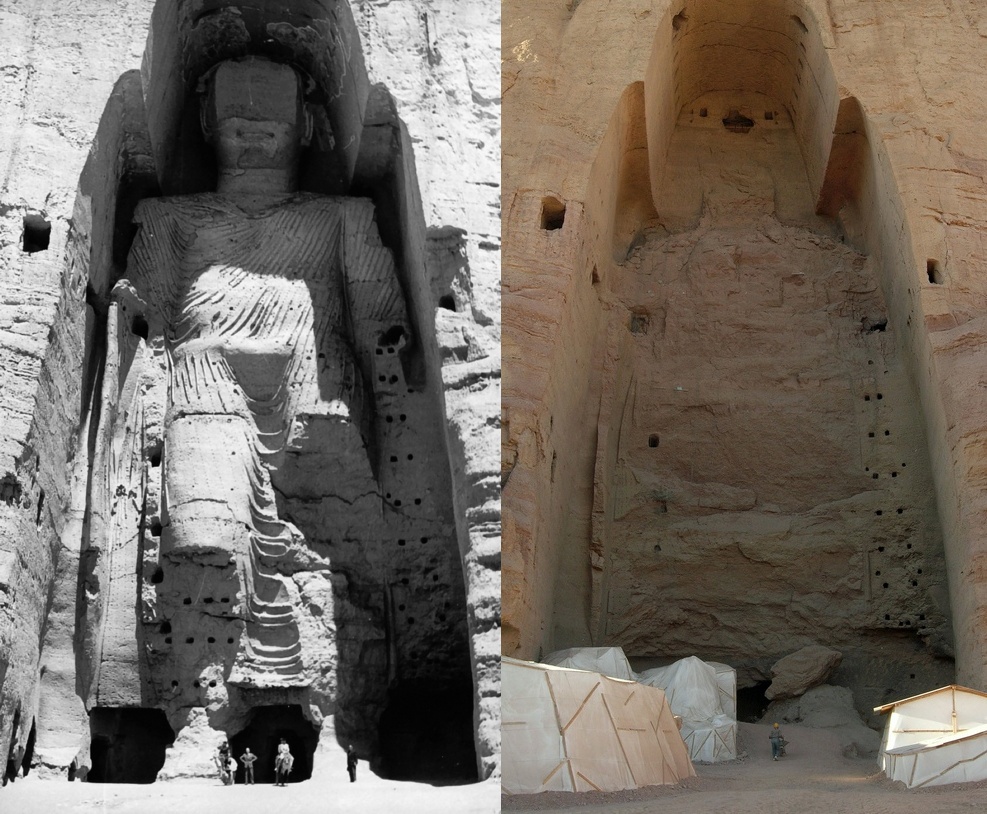
“Taller Buddha of Bamiyan before and after destruction” by Buddha_Bamiyan_1963.jpg: UNESCO/A Lezine; Original uploader was Tsui at de.wikipedia.Later version(s) were uploaded by Liberal Freemason at de.wikipedia.Buddhas_of_Bamiyan4.jpg: Carl Montgomeryderivative work: Zaccarias (talk) – Buddha_Bamiyan_1963.jpgBuddhas_of_Bamiyan4.jpg. Licensed under CC BY-SA 3.0 via Wikimedia Commons – https://commons.wikimedia.org/wiki/File:Taller_Buddha_of_Bamiyan_before_and_after_destruction.jpg#/media/File:Taller_Buddha_of_Bamiyan_before_and_after_destruction.jpg
Religious Liberty and Imagery
Religious Liberty is a hot topic:
- In 2001 the Taliban destroyed two Buddhist statues that were on the historic Silk Road. This destruction was condemned throughout the West but the action is part of a long line of what we call iconoclastic behavior. More recently ISIS has been destroying ancient religious statuary in Iraq and Syria.
- After the Supreme Court decision legalizing same sex marriage many conservative religious communities including Christians have concerns about infringement of religious liberty. Christian colleges are facing the possibility of the loss of accreditation and Federal financial aid if they don’t remove sexual behavior morality guidelines that conform to traditional Christian sexual norms.
- “We are under attack by Muslims at home and abroad,” Franklin Graham, head of Samaritans Purse and the Billy Graham Evangelistic Association, wrote on his public Facebook page on July 17. “We should stop all immigration of Muslims to the US until this threat with Islam has been settled.” At press time, more than 167,000 people had “liked” the post. CT
- Ideas about religious liberty developed in the West after hundreds of years of warfare between Protestant, Catholics, Muslims and waves of persecution against religious minorities like the Jews.
The Bible and Religious Freedom
My guess is that most American Christians would declare that religious freedom is a good thing. Few of them have probably read Deuteronomy 12 and 13 and pondered the implications of such a text. Does God demand that we destroy idols if we have the opportunity? Does God demand that we abolish worship of other gods in our land? Does this make God opposed to our Western ideas of religious freedom?
You may comfortably feel removed from the prospect of destroying a Buddhist or Hindu idol or burning down a Mosque or Synagogue but the implications of the passage go even deeper. While we might by virtue of our cultural context fairly easily resist uglier forms of anti-religious pluralism the text also commands Israel centralize its religious practice. It has long been common throughout the world to “free-style” your own religious. Build your own private altar in your home to a god or saint of your own choosing.
- In England Jediism or the Temple of the Jedi Order is recognized.
- The Jedi religious is ironically close to the Temple of Satan religion
- Most Americans don’t bother with any of these kinds of religious but freely mix and match what they feel or believe usually from a hodgepodge of older better established religions.
Deuteronomy 12 and 13 seek to establish centralized control of the religious life and belief of Israel and purge the nation, with violence if necessary, of any religious pluralism. How should we read this passage? How should it be applied by Christians today?
Christians Reading Deuteronomy in the Christian Canon
While it may be understandable for an observant Jew in the modern state of Israel to attempt to literally apply Deuteronomy 12 and 13 to contemporary Palestine it’s far harder for Christians to imagine a simplistic literal application for ourselves.
- Israel’s centralized tabernacle and temple were often corrupt
- The Temple and the law failed to destroy Israelite idolatry as much of the Old Testament bears witness to
- On Palm Sunday Jesus symbolically destroys, fulfills and replaces the temple in himself
- Jesus himself was a religious outsider who would be killed by the centralized temple authority structure. This same structure would persecute his apostles like Paul, John, James and Peter.
- We don’t find New Testament Christians fomenting public iconoclastic agendas but rather purging their own lives of pagan temple idolatry and practice.
Other Manifestations in Christian History
- Christianity has had numerous iconoclastic movements that violently attacked both non-Christian and competing Christian traditions.
- One might argue that denominationalism itself is an implicit failure to have a central religious authority and community within Christianity.
- The Protestant Reformation with its standard of everyone reading and interpreting the Bible for themselves greatly proliferated the number of individual religious expressions and the need to coexist in a productive, peaceful way requires that we don’t get ultimate about every little religious idea and practice with which we all differ.
- Secularization and the privatization of religion has expanded this even further with nearly everyone imagining their own private interpretations or even revelations.
- In recent decades especially in areas of Evangelical influence people will commonly say things like “I don’t need to go to church to be a Christian. Christianity is about my relationship with Jesus/God and no one has the right to judge the quality or validity of that but me.”
- There is a broader, cultural version of that today that we would simply call “spirituality” where it is imagined to be more authentic to construct your own spirituality, deity or path and because we imagine we can’t know anything publicly about the supernatural or divine one person’s construct must be as good as the next, as long as it works for you.
How should this command impact you
Given all that I have listed above, what this command does is break one’s relationship with God out of a private, personal, sphere and make it public and communal.
If your relationship with God is something that only true for you, or only true behind closed doors, or only about your thoughts or feelings about God as you harvest spiritual ideas as you go through your week you’re not actually getting out of your own head and coming into contact with anything beyond your own imagination.
Israel is commanded to come together as a community to meet God. This makes their relationship with God less subjective and more real, real like other people are real. It limits their vulnerability to having God be a reflection of their own wishes or fears, which is always a problem with any personal relationship. The command seeks to have one true God be real to his people.
So on one side we have the pitfall of subjectivity. As long as I keep my god as a product of my own feelings or desires, I’m not really dealing with any god beyond my own imagination.
Religious Tyranny
Figuring out how our public faith productively intersects with our religiously pluralistic society is not an easy task. The reason Western Civilization went the way it did with attempting to enshrine religious liberty is because of the endless religious wars that ensured and engulfed Europe for generations. Currently in the West we don’t face the threat of religious intolerance backed by government power. We tend more to face the threat of ideological intolerance backed by government power.
While since the 60s everyone was afraid that “relativism” would be the great threat, we’re now in a moment where different ideological moralisms prevail. Here is a blog post from a Roman Catholic woman who for years identified as a lesbian but now lives in a traditional heterosexual marriage.
This brutality is fuelled by a sense of absolute moral righteousness, and by complete contempt for anyone who doesn’t immediately fall in lock-step with one’s own convictions. Perhaps the greatest weakness of the left is the increasing reliance on bullying tactics in order to silence those who disagree – or even those who simply don’t understand. To the righteous warrior, the justice of the cause is so self-evident that the only possible reasons for failing to believe in it are obstinacy, privilege, entitlement, stupidity or simple evil.
The irony is, that this lack of compassion is often promulgated in the name of compassion. It’s as though mercy were a scarce capitalist commodity: one over which different marginalized groups vie for a monopoly. The result is that disadvantage and lack of privilege become a kind of swag that people show off in ridiculous contests of intersectional one-up-manship.
Not only does this make social justice look stupid, petty and barbaric to people on the right, it also creates a toxic environment for anyone who wants to try to advocate for marginalized groups. You have all of these warring groups of downtrodden, politically disempowered people fighting among themselves for the biggest piece of the victimhood pie – and if someone with privilege, influence or power tries to intercede on their behalf, that person can basically expect to be torn to pieces for having the affrontery to enjoy power, inluence and privilege in the first place.
Seeing Deuteronomy 12 and 13 through Jesus
What we see in Deuteronomy 12 and 13 is the serious danger of humanity left to its own religious, moral and ideological imagination. Israel, at that point in time is commanded by God to be subject to the real God revealing himself in one place and time. The experiment is an utter failure. Israel cannot keep the law. Israel will abuse a centralized temple and use it towards her own destruction.
What we find in Jesus is not simply a centralized place or worship but also a human voice, in our time and space. Jesus, unlike the temple is able to modulate the relationship between centrality (not succumbing to our subjective wishes and fears) while also affording space and time for the kind of process required for sinful people to be more freely drawn to him. Jesus does not extinguish the smoldering wick or break the bruised reed.
Jesus allows us to say two things at once:
- We must come to Jesus because he is the only place to find life and rescue
- We are asked to come to him freely and hopefully rather than simply formally or under legal duress.
The Coconut, the Peach, and the Tomato
A preacher in England used a terrific analogy for different kinds of churches which are essentially different ways of thinking about this dilemma of truth and human frailty.
A coconut is incredibly hard on the outside with its sweetness all locked up secure. The hard shell is sort of like the law. It is uncompromising, unyielding, but also fully exterior. You must first conform before you are able to taste the goodness. For those who are able to conform at least to a degree there is promise, but there are many who by virtue of their history, their upbringing, their temperament this law becomes an obstacle which will keep them locked out.
In many ways both the Old Testament law and the new moralism are like coconuts. There are many barriers for entry, the difference is the barriers that are imagined.
A tomato has no barrier at all. You don’t need to do any work to get into its goodness. It is, however, completely vulnerable. It can be crushed, squashed, lost. It finally has little enduring substance. It is like our subjective religious impulses. We make up God, morality, and usually are only able to imagine community or pull of relationships for just a short time because we are slaves to our individual fears and desires, trying to make community work with others who are slaves to their own as well. In the end everything falls apart. If the Old Testament law and modern moralism are like the coconut, the tomato is like the completely subjective approach many try today. It seems at first to be the path to happiness and community but in the long run it cannot be sustained because there isn’t anything hard or enduring.
A peach, however, is soft on the outside but has a core that is strong and will endure. Jesus is both able to be patient and gentle with those in process but he himself has identity and a solid core. This helps him avoid the subjectivity trap but also not simply stonewall those who struggle.
Misery
As with many things misery comes in different flavors
- If your god is subject to your own subjective wishes or fears you will in the end be utterly alone, with yourself as a god unable to meaningfully connect to an actual God who may contradict you and unable to form solid meaningful relationships with others who also are not subject to your wishes or fears.
- If your strategy is an uncompromising law, whether that be a traditional form or a new moral ideological form you will also finally be alone and cut off from God.
Deliverance
Deliverance comes because we cannot keep the law. We cannot break the coconut and the tomato leaves us only with ourselves. Jesus fulfills the law of Deuteronomy 12 and 13 becoming himself both the solid center, the one objective authority in heaven and in earth but not in the form of a law but of a person who can judge what we need, who can be gentle and patient as he draws us to himself.
Gratitude
As with all of the Old Testament law what remains is the heart of God as seen through Jesus. We now, unable to fulfill the law as entrance requirement (coconut) respond to Jesus in gratitude, learning freely how to please rather than how to qualify.


 Leadingchurch.com
