
Who to Believe?
We are awash in conflicts about important and relevant issues:
- Are our CO2 emissions killing the planet and leading to an environmental catastrophe or are these the overblown fears?
- Are illegal immigrants destroying our country or are these new immigrants the life blood of America’s future?
- Do we need to take a direct, active role in fighting wars in the middle east to insure our safety from terrorists or should we keep our distances from that quagmire of intractable religions and political chaos?
- Is the formula for economic revitalization tax cuts and de-regulation or do we need to bring down the big banks and have the government redistribute income through minimum wage and tax increases?
- What is the true path and who has the authority to lead us out of our crises?
- What is sex and marriage for and who gets to decide what is moral and legitimate about it?
The End of the World as we Know It
It’s easy to look at these challenges and get emotionally apocalyptic. Have we ever faced challenges like these?
Well, if you look back into the twentieth century you’ve got the cold war, two world wars, an influenza pandemic, nuclear proliferation, communism, fascism, etc. You’ve got hurricanes, tornadoes, tsunamis, earthquakes, volcanoes, droughts, floods, famines, etc.
Everything is Amazing
One of the strangest things about our present time really aren’t the threats. Life on planet earth for human beings has always been brief, hard, painful and insecure. The strangest thing about our time has actually been the relative security and prosperity. We live in a context where we the vast majority of children make it past age 5, and a good many people live into their 70s or 80s.
We also live within an imaginative world where marketers pump into us expectations of ever increasing wealth, comfort, affluence and security provided to us by government, technology and the goodness of our kindly neighbors at home and abroad.
Louis CK on Conan famously added some perspective.
Jesus’ Long Journey to Jerusalem
Most of the middle of the Gospel of Luke revolves around Jesus’ journey to Jerusalem. Luke elevates the dramatic tension around Jesus as he travels to Jerusalem. It will be in Jerusalem where Jesus will confront
- The story of God’s mission to the world through Israel
- The contemporary power struggle for authority that was being played out in conflict between the various Jewish factions and the larger world power of empire through Rome
If you scan the topics of Luke chapters 19 through 21 you’ll see that they all revolve around conflicts over money, marriage, power, with all of the different factions claiming authority and vying for legitimacy.
When Will You’re Reign Begin?
Luke 21:5–9 (NET)
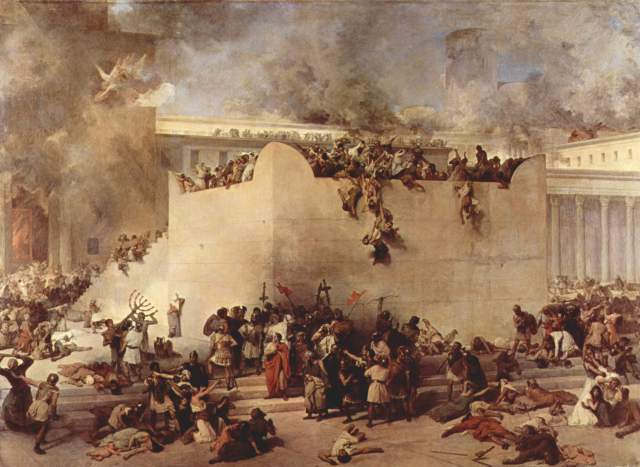
5 Now while some were speaking about the temple, how it was adorned with beautiful stones and offerings, Jesus said, 6 “As for these things that you are gazing at, the days will come when not one stone will be left on another. All will be torn down!”7 So they asked him, “Teacher, when will these things happen? And what will be the sign that these things are about to take place?” 8 He said, “Watch out that you are not misled. For many will come in my name, saying, ‘I am he,’ and, ‘The time is near.’ Do not follow them! 9 And when you hear of wars and rebellions, do not be afraid. For these things must happen first, but the end will not come at once.”
The set of questions the disciples have in mind are nuanced and complex here especially in relationship with all that Jesus has been trying to teach them.
What is clear all along about the disciples was that they were always trying to fit Jesus into the pattern of the world that they held in their minds. They were hoping, anticipating that Jesus’ “arrival” at Jerusalem would mean an assumption of power and authority into the present framework of power, authority, economics and society which was all that the disciples had known. The central piece of that entire worldview was the temple itself.
The temple was the central figure in the Jewish imaginary. It tied the present time all the way back to the exodus and the tabernacle. It was the stone and gold expression of Israel’s unique place in the story of the world as “firstborn” of Yhwh, the creator God. It defined the relationship of power and resistance to Rome and all of the cultural elements that conflict embodied. The temple was the center of the world for the disciples and all of the Jewish people and the central manifestation of their core narrative. This was why Jesus had to go to Jerusalem and in the minds of his disciples would be defined by his relationship to the temple. Again, in the minds of Jesus and everyone there the temple was the stage that Jesus must play upon.
If you go back and read Luke 19 and 20 you’ll see how radical Jesus’ message is. Jesus makes the audacious, and in the minds of many of his Jewish listeners blasphemous claim that the temple does not define Jesus but rather Jesus defines, supersedes and in fact replaces the temple. The temple’s role was to give physical manifestation to Yhwh, the unseen God of the Hebrews hence lending legitimacy and authority to whomever controlled it physically and in the minds of the Jewish faithful. This is why the temple was such a big deal for Herod, Rome, the Essenes (against it), the aristocracy, the Pharisees and the Sadducees. Jesus reverses that by claiming that now that he has come the temple is obsolete both in what it represented (the physical presence of Yhwh) and its function (the means by which a holy God can live amidst an unclean people). It is absolutely no wonder that by what Jesus said and did when he got to Jerusalem all of the present actors had little other option than to kill him.
What Impresses us and Why it shouldn’t
When the disciples are marveling in the architectural wonder that the temple building was designed to evoke Jesus makes the claim that this entire artifice in short order will be demolished destroying the stage upon which the petty powers vied for legitimacy and authority.
There is a lesson in this for us. We are cast as the disciples in this narrative. We frame Jesus within the petty, temporary authorities and structures of our time seeing him as a tool within them acting to bring these stories lines to the conclusions we imagine are important. Like the disciples we imagine Jesus will be the means by which we claim our desired positions within the present framework.
To us, as to the disciples, Jesus declares that the artifices and artifacts we are impressed by and emotionally wedded to are sure to crumble before him.
Jesus’ “Little Apocalypse”
What follows in Matthew, Mark and Luke is one of the most debated parts of the canonical gospels. NT Wright in his Jesus and the Victory of God believes that the two dominant contemporary readings of this passage both miss the mark historically.
The reading by those wishing to reconstruct a “historical Jesus” see this as a post temple destruction passage where Jesus mistakenly declares his imminent return.
The fundamentalist reading of the passage has turned it into a search for clues to the timing of the future second coming Jesus launching each generation to find the signs to validate their own narrative. Remember the cold war Hal Lindsey 1980 Countdown to Armageddon.
Wright’s assertion is that Jesus is best understood as using the tools of the prophetic tradition. The key to all of it is the Son of Man figure from Daniel who goes with the clouds of earth INTO heaven to receive power and authority to establish and rule an eternal kingdom.
Who is Jesus Talking to? What is he Talking about?
Part of the dilemma we have with these kinds of passages is the question of time and audience.
- The gospels report what Jesus tells his disciples. The assumption is that this information was important and helpful to them.
- The gospels tell us what Jesus said to his disciples. The assumption is that this information is important and helpful to us.
When you get into a matter like this one where we are conflicted as to whether Jesus is informing his disciples about an event that will happen within their lives, such as the destruction of the temple in Jerusalem in 70AD, and how the prophesying of this event impacts their and our view of Jesus.
The matter of Jesus foretelling the destruction of the temple is interesting in that Jesus was not alone in imagining Rome coming down to finally resolve “the Jewish question”. In the minds of Jesus’ disciples and most Jews alive at their time THE question was whether and how Yhwh would make good on the Old Testament promises to his people and what that would look like. The Jewish factions of the first century were deeply split on this and split on how they were either cooperating or impeding the work of Yhwh to reclaim his people. Rome’s violent destruction of Jerusalem was hardly an unimaginable possibility for someone in Jesus’ day and Jesus was not alone in declaring such an event as coming.
What is important is Jesus’ declaration of HIS role in this whole drama and he does so with identifying himself as the Son of Man and his actions in fulfillment of the story of Israel.
How Jesus Concludes
Luke 21:25–36 (NET)
25 “And there will be signs in the sun and moon and stars, and on the earth nations will be in distress, anxious over the roaring of the sea and the surging waves. 26 People will be fainting from fear and from the expectation of what is coming on the world, for the powers of the heavens will be shaken.27 Then they will see the Son of Man arriving in a cloud with power and great glory. 28 But when these things begin to happen, stand up and raise your heads, because your redemption is drawing near.”
29 Then he told them a parable: “Look at the fig tree and all the other trees.30 When they sprout leaves, you see for yourselves and know that summer is now near. 31 So also you, when you see these things happening, know that the kingdom of God is near. 32 I tell you the truth, this generation will not pass away until all these things take place. 33 Heaven and earth will pass away, but my words will never pass away.
34 “But be on your guard so that your hearts are not weighed down with dissipation and drunkenness and the worries of this life, and that day close down upon you suddenly like a trap.35 For it will overtake all who live on the face of the whole earth.36 But stay alert at all times, praying that you may have strength to escape all these things that must happen, and to stand before the Son of Man.”
Signs in the Heavens
If you want to understand the first paragraph of this section you need to be steeped in the tradition of Old Testament prophesy. There are references to “the day of the LORD” tradition and the Daniel 7 “Son of Man” tradition. These are stock images for political, military, religious and ecological upheaval that uproots human assumptions of power and control. The church has long heard this passage as Jesus talking to his disciples about the dramatic upheaval that will overtake them and their assumptions about established order and the upheavals that contrary to contemporary middle class American sensibilities are standard in human history.
Amid these upheavals we see Jesus, as in Daniel 7 coming to heaven with the clouds inheriting a kingdom of power and authority. Now remember, this is Jesus speaking to his disciples BEFORE his arrest, execution, resurrection and ascension. This is a response to the question of his disciples that asks “When Jesus will you assume the power of the structure within which we imagine you?” Jesus’ answer is that in fact he will assume the power and authority of the whole world, eclipsing the temple. The imagery of the heavens for the ancients would be all about governing authorities and the changing of the administration of heaven and earth.
The Fig Tree
The mention of the fig tree ties all of this to the temple. It also locates the “this generation” to the destruction of the temple and that destruction being understood as vindication of Jesus’ words.
Application
Application only fits if you handle the time dilemma. If you imagine this text only speaks to the apostles then the application only fits them. If you imagine this text only speaks to some final chronological generation, wasted on all previous generations then the application only speaks to them. Through this text Jesus speaks to us, as he did to our parents 50 years ago and each generation prior to this one.
We stand with the world both invested in the institutions and issues of our present day like the disciples trying to fit Jesus into them. Jesus gives his disciples a sober word about this investment in their view of the temple inviting them to see him eclipsing the temple in its mission and function. He prepares them for what is to come, the undoing of the pieces of their world which is a pre-echo of the undoing of all empires of all the earth. Jesus himself as the Son of Man figure from Daniel 7 has been given an eternal kingdom which will supplant all rivals. These upheavals will continue until the final upheaval.
The haunting challenge of the passage comes in verse 36. We will stand before the Son of Man and be called upon to give an account of what we did with our times. Jesus admonishes vigilance over our hearts through sobriety and prayer.
This is in contrast to the culture wars fought in Jesus time, our time and every age. People responding either by trying to grab power or escape anxiety through all the ways we distract ourselves from the concerns of the age.
One of my favorite text on this is from Tolkien’s Lord of the Rings. Gandalf is educating Frodo on the history of the ring that he has inherited and its dark history. Frodo simply wants to live a quiet hobbit life in his comfy hole surrounded by family and friends. Now suddenly the concerns of this world come crashing down on him in the form of this ring and now he must deal with it.
‘I wish it need not have happened in my time,’ said Frodo.
‘So do I,’ said Gandalf, ‘and so do all who live to see such times. But that is not for them to decide. All we have to decide is what to do with the time that is given us.
J.R.R. Tolkien (2009-04-17). The Lord of the Rings (p. 51). Harper Collins, Inc.. Kindle Edition.
Here We Stand
Here we stand like hobbits impressed by the buildings, the institutions, the histories, the powers and principalities of this world gazing up at them in wonder and amazement.
Jesus comes to us to inform us that he eclipses them all. I imagine we like the disciples while not wanting to nay-say him are filled with doubts and disbelief in this. “How could one man with not Roman or temple title stand against all of this?”
Jesus remarks that the temple will pass. In this we hear that all such things will pass, the things that draw our wondering gaze. When they crash down, as they always do, we should look again to Jesus and wonder how when all of this falls He always remains.
We then must turn and examine ourselves in preparation to face the Son of Man. What have we done with the times we have been given?


 Leadingchurch.com
Pingback: Leadingchurch.com
Pingback: Why Your Moralism Cannot Save The World | Leadingchurch.com