
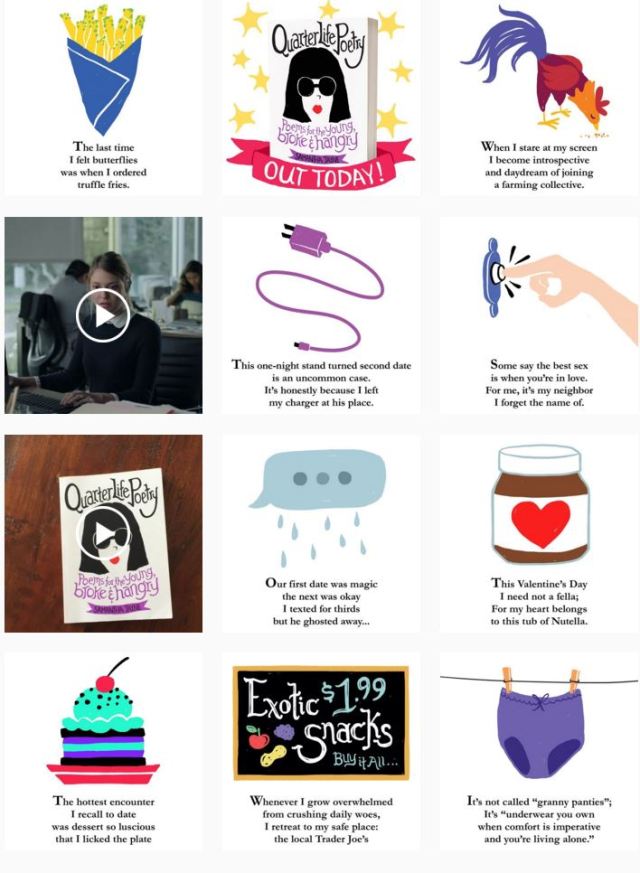
Fifteen months ago Samantha Jane was an aspiring actress and artist who began writing little poems on Instagram about her experience as a 26 year old woman. It took off. She’s now got nearly 100,000 followers on Instagram and a new book out Quarter Life Poetry: Poems for the Young, Broke and Hangry which is #1 in the Amazon category “Poetry by Women”.
And Over in Millennial Christian Land
One of the newer, hotter authors in Millennial Christian land is Calvin College Philosophy prof James KA Smith with his Augustinian redux entitled You Are What you Love. Smith got attention with his earlier more academic book Desiring the Kingdom that explored how the shape of lives creates “liturgies” that form our hearts and desires.
Samantha Jane lives amidst contemporary millennial liturgies that have formed her and her Instagram poems are perhaps her version of the book of Proverbs. While I didn’t go too deep into her Instagram feed a number of the the “greatest hits” postings a number of them clearly speak to dating and sex.

They speak of longing. Longing for love. Longing for joy. Longing for permanence in a world where everyone is a free agent looking to maximize their gifts. Do they have the looks, the wit, the charm, the connections, the je ne sais quio necessary to arrive at whatever it is arriving looks like.
How to Catch a Mate
Technology has obviously changed the practices of the world deeply. This week Our World in Data produced a chart on the differences between 1939 and today in terms of what men and women want in a marriage partner. In less than 100 years ideas have changed. Mutual attraction and love shot to the top of the charts, and chastity has shot to the bottom.
They instinctively imagine that by virtue of technology and social change no other generations could possibly understand or inform them. Watch as parents give Tinder a whirl.
OK Cupid in their video on the metrics of dating notes that while some of these things change other things don’t change. Women are usually attracted to men about their age while men are attracted to 22 year old women.
The more things change…
The Washington post piece noting Samantha Jane’s rise also noted that she follows a list of others who blazed a similar trail.
The popularity of the sitcom’s (Lena Dunham’s “Girls” on HBO) messy and self-confessional nature certainly paved the way for interest in books such as “Quarter Life Poetry.” Still, being dismayed in your 20s is not actually a new phenomenon. Before Dunham, there was Emily Gould, the Internet’s first queen of oversharing, who blended heavy doses of self-analysis into her takedowns of the New York elite for Gawker and landed a book deal; so did Joyce Maynard way back in 1972, after she spilled her jaded take on growing up in the 1960s for the New York Times. Most notably, perhaps, was Elizabeth Wurtzel, who published her memoir “Prozac Nation” in 1994, when she was just 26.
This “rite of passage” lit is sobered by a bit of sociology and a lot more ethnic, classis and geographic diversity. The picture of the “average” 29 year old American is far less glamorous.
Instead, the average 29-year-old did not graduate from a four-year university, but she did start college; held several jobs, including more than two in the last three years; is not as likely to be married as her parents at this age, but is still likely to be living with somebody; is less likely to own a home than 15 years ago, but despite the story of urban renewal, is more likely to live outside of a dense urban area like Brooklyn or Washington, D.C.
Anxious social scientists track them against the benchmarks of previous American generations tracking mile markers like marriage, home ownership, and relative income levels. The transition from adolescence to mature adulthood usually has everything to do with the less glamorous practicalities of life revolving around food, shelter and bringing up children. The hope is that one can find the right partner, the right community, the right context to launch one into stability through those long years of adult life.
Naomi and Ruth
The catastrophes that Naomi has been lamenting were the implosion of what was supposed to be her mid life passage and the falling apart of Ruth’s launch into adulthood. Ruth lost her husband, her ticket to children which in the ancient world was the second stage rocket that would validate her culturally and secure her economic security. Now they are struggling for survival in Bethlehem with Ruth gleaning in the field of Boaz.
Last week Naomi seemed lost to daytime TV while Ruth got to work the favorable attention of Boaz in Ruth suddenly activates Naomi’s womanly survival instinct. While Naomi previously declared she returned back to Bethlemen “empty” now she’s all about securing Ruth’s future, or so she says.
Ruth 3:1–6 (NIV)
1 One day Ruth’s mother-in-law Naomi said to her, “My daughter, I must find a home for you, where you will be well provided for. 2 Now Boaz, with whose women you have worked, is a relative of ours. Tonight he will be winnowing barley on the threshing floor. 3 Wash, put on perfume, and get dressed in your best clothes. Then go down to the threshing floor, but don’t let him know you are there until he has finished eating and drinking. 4 When he lies down, note the place where he is lying. Then go and uncover his feet and lie down. He will tell you what to do.” 5 “I will do whatever you say,” Ruth answered. 6 So she went down to the threshing floor and did everything her mother-in-law told her to do.
The Threshing Floor
To fully appreciate the importance of this scene we should first remember that marriage in the ancient world, even up until very modern times prioritized family status, property claims and heredity. For this reason marriages were often entered into as part of family negotiations. We would imagine that if it is Naomi’s intention for getting Ruth a husband that she would go out as the Israelite, the last connection to the house of Elimelek and try to negotiate a match for her. Naomi doesn’t do this, either because she didn’t believe they were in a position to make a good match or there was really no legal claim she could make. She resorts to an approach that is haunted by other texts.
In the book of Genesis when Judah fails to offer his youngest son to provide children for Tamar she takes up the clothing of a prostitute and lures Judah into bed. In a climactic scene where Judah demands Tamar’s death for adultery Tamar reveals that it is Judah who has failed to keep faith and she is honored for her cleverness and courage. Notice that Naomi’s plan here explicitly mentioned Ruth’s preparation with clothing.
As we mentioned the first week we also have the story of Lot’s eldest daughter who gave birth to Moab after getting her father drunk on wine. Notice here too Naomi’s plan involves waiting until after Boaz and the others have celebrated the harvest by eating and drinking before Ruth is to make her approach. We see that in some ways Naomi has been thinking like the mother of Moab while Ruth has been the picture of obedience and faithfulness.
The most debated element of the story is the command to “uncover his feet and lie down”. Throughout the centuries of interpretation scholars have debated the meaning and nuance of this command.
- Some see it as commanding Ruth to simply lie down at a space by his feet and uncover his feat.
- Others note that in the Hebrew Bible “feet” are sometimes a euphemism for the penis. Is Naomi suggesting that Ruth make a provocative act of seduction?
- Still others note that the language is ambiguous and the “uncovering” language here is not usually uses with a man as an object but a woman. Is Naomi suggesting that Ruth uncover herself at the feet of Boaz? This hypothesis makes the most sense of the symbolic spreading his coat over her (remember the “wings” comment in 2:12).
However you interpret the passage Naomi’s strategy is clear. Since neither she nor Ruth have any power to wield to improve their prospects Naomi plans to use the only card she sees, Ruth’s value for sex and childbearing as a young woman. She hopes to engage Boaz at his weakest moment, echoing the Lot episode in hopes of perhaps one way or another securing some obligation that they can exploit for their own future security. Will it work?
The Test of Boaz
Ruth does as Naomi has directed and now, in the middle of the night after feasting and drinking Boaz wakes with a start to find Ruth, in whatever state, as his feet. What should he do? Naomi has banked on beer goggles but will Boaz fall into the trap?
We should remember also Numbers 25 when the daughter of Moab were used by their king to lure the sons of Israel into bed, marriage and idolatry. This story haunts the imagination of the Biblical reader. Is Naomi like a king of Moab? Is Ruth like one of those daughters of Moab looking to lure vulnerable Boaz into a situation where he will be obligated to care for Ruth and also Naomi?
Boaz shows himself of the highest quality. He takes the situation in the finest possible light. He again praises Ruth for this kindness she shows him but then also mentions that it would not be appropriate for him to respond to her invitation because there is one person closer in the family order to Elimelek who should first be able to redeem the property belonging to the family.
Boaz makes sure that Ruth leaves before anyone might see her, something that might jeopardize her honor and reputation. He also sends her home with food so as to make an impression on her mother-in-law.
Ruth and Naomi are pleased and excited. It worked out better than Naomi could have imagined and she assures Ruth that Boaz will do what is needed for them, and quickly.
Misery: “God can’t bless a mess”
I will sometimes hear Christians say things like “God can’t bless a mess” but I disagree. If God would wait for us to clean up our own messes he wouldn’t have time to save us. One of the most alarming things about God is that he regularly offends our diverse biases. As Christians we are constantly making rules for God about what God will and won’t bless and in my experience God blesses who we imagine is unworthy and works through things that we declare would be beneath him.
Naomi here looks shrewd and manipulative. Ruth’s self-giving character now in Naomi’s hands seems bent towards the worst possible service, almost making Ruth re-enact the actions of Moab’s mother and the machinations of the King of Moab in attempted assimilation of Israel in Numbers 25. Ruth plays right into Naomi’s hands yet God uses even this for good, just as he did with Tamar playing the prostitute and sleeping with her unrighteous father-in-law.
Every time we say “God can’t do this” he does. That isn’t encouragement to make the messes we do, because we usually suffer for them, it simply states what Jesus noted in John 3:8 “the Spirit blows where it wills…”
Deliverance
Just as Ruth has been giving what Naomi doesn’t deserve now it’s Boaz’ turn to be used by God. We’ll see that Boaz, like Ruth, blesses those who are not worthy and sacrifices greatly to redeem the undeserving. Boaz saves Ruth from the plan of Naomi and makes preparation to redeem the house of Elimelek.
What we are invited to do is to see the grace and goodness of God as expressed in the shape of the sacrifice of his redemption. What we see from Jesus is that again and again the Pharisees and the teachers of the Law wish to designate who God can and can’t save but here we see God using ways and means, including an instrument of Roman imperial terror to rescue us from ourselves. Jesus meets with the likes of Nicodemus who was considered righteous and holy while he also met with tax collectors, prostitutes and sinners. He saves one of the nationalist insurgents crucified next to him. This is the promiscuity and the surprise of his love.
We commonly imagine that we will trap Jesus with the assets we possess. We will lure him with our obedience, or our loyalty to church, or gifts that we give to others, or ways that we help the needy. None of this counts for anything in terms of his deliverance for us because when we look around we find the jails filled with murderers and rapists and child molesters who in the misery of their calamity come to him and receive relationship with him just as the purest, most upstanding citizen.
Gratitude
It is in gratitude that we have the space for obedience and holiness.
Samantha Jane will likely continue to age, only to discover that her sharp wit while sufficient to land her a book deal might not be what it really takes to bring her her dreams. In fact she will probably discover that it is often exactly when she thinks she’s getting what she wants that she finds is empty and failing to satisfy.
What God really wants to give us is the greatest thing, which is himself. Once you have God nothing else will satisfy and few other things count. This means that you can have little of what the world suggests is essential while being satisfied and generous with whatever the world imagines you do have.
Our obedience is not something we offer to God to get something, it is what we offer to God because he has given us everything.


 Leadingchurch.com
Pingback: What Do You Love? | Leadingchurch.com