

Top Posts
- Miroslav Volf on God's violence or ours
- Status
- Revelation 17: The Beast Consumes the Whore, where the relational polarity of the age of decay always leads
- Origen's 3 Level Interpretation of Scripture
- Christianity is not about being nice
- The Roadside Hookup That Changed the World
- Why you’re secretly addicted to food porn
- Experimental Theology: Edging Toward Enchantment: A Sacramental Ontology
- Two Americas of 2016
- Peter Schurman on the Ben Op
Category Cloud
Blog note book review book writing CRC Culture commentary Daily Links and Notes Devotional Reflection How to become a Christian Institutional Church Link Compilations Links Missional On the way to Sunday's sermon Pastoral Identity philosophical reflection Quotations Saved Blog Comments Saved CRCVoices Posts Sermon Illustrations Sermon Outline Sermon Recordings Tech tools theological the self Tweets Uncategorized Understanding the Bible Video Wisdom YouTube Comments to RememberTag Cloud
- Abortion
- Acts
- Advent
- Advent 2014
- age of decay
- age to come
- Benedict Option
- book of Leviticus
- Calvin College
- Charles Taylor
- Christianity
- Christmas
- City Church San Francisco
- Confessional conversation
- CS Lewis
- David Brooks
- Donald Trump
- Douthat
- Dreher
- Esther
- Exodus
- faith
- Genesis
- hell
- Inspire2017
- James
- Jesus
- John Suk
- Jonathan Haidt
- Jordan Peterson
- Katy Perry
- Keller
- Kierkegaard
- King David
- King Saul
- Lent
- Leviticus
- Meme of the week
- Moses
- NT Wright
- Palm Sunday
- Pentecost
- Peter Enns
- Peter Kreeft
- Pope Francis
- Progressive Liberationism
- raising of lazarus
- RCA
- reflected self
- relational polarity
- Religion
- resurrection
- Rob Bell
- Rod Dreher
- Ryan Bell
- Skye Jethani
- SSM
- Steve Jobs
- Synod2015
- Synod2016
- the book of exodus
- The Book of Judges
- The book of Kings
- The book of Leviticus
- The Book of Luke
- the book of Numbers
- The Book of Samuel
- the Gospel of John
- The Gospel of Matthew
- The Road to Character
- the self book
- The Ten Commandments
- Tim Keller
- Tom Holland
- transgender
Twitter Feed
Tweets by paulvanderklay
Want to reduce inequality? Try the Black Death. – The Washington Post
Posted in Daily Links and Notes
Leave a comment
Neal Postman “Amusing Ourselves to Death” was right
What Orwell feared were those who would ban books. What Huxley feared was that there would be no reason to ban a book, for there would be no one who wanted to read one. Orwell feared those who would deprive us of information. Huxley feared those who would give us so much that we would be reduced to passivity and egoism. Orwell feared that the truth would be concealed from us. Huxley feared the truth would be drowned in a sea of irrelevance. Orwell feared we would become a captive culture. Huxley feared we would become a trivial culture.
Posted in Daily Links and Notes
Leave a comment
Matthew Lee Anderson writes on Vox trying to explain the pro-life movement
Posted in Daily Links and Notes
Leave a comment
“How is a worldview taught?” Dallas Willard
Book recommendation by Willard. The making of the modern university
You are in a system that teaches a worldview without responsibly defending it.
How is a worldview taught?
Mainly its taught be body language, facial expressions, tones of voice and inflections, looks, off-hand comments about people and events. By what is permitted.
By example, how we treat people
By who gets rewarded or punished in various ways.Rarely by explicit statements. Explicit statements are used only to reinforce what is taught indirectly
It is modeled.
We have a kind of orthodoxy that is a sociological reality, not a rationally supported outlook.
Dallas Willard on not having to have the last word
Here is something I read when Willard died.
In one of his classes a student challenged him with statements that were both offensive and incorrect. Dallas paused and told the class that that was a good place to end their discussion. Somebody asked Dallas afterward why he had not countered the students’ argument and put him in his place. “I’m practicing the discipline of not having to have the last word.”
This is part of why Dallas would never debate non-believers. He would engage in a mutual conversation where both parties could seek for truth together. He would often say: “I’m sure Jesus is the kind of person who would be the first to say you must ruthlessly follow the truth wherever it leads.” Through the last week of his life he was still hoping to help believers engage non-believers by looking together at questions where people get stuck in their actual lives rather than by trying to win arguments.
I hear that same thing rolling through the Divine Conspiracy especially on oath taking.
The essence of swearing or making oaths is to try to use something that, though impressive, is irrelevant to the issues at hand to get others to believe you and let you have your way. This is wrong. It is unlike God. And just making sure you perform on any promises made to God in the course of it (the old rightness) does not make it right. Of course you should keep promises you make to God in any circumstances. But the wrongness of swearing lies deeper. We are making use of people, trying to bypass their understanding and judgment to trigger their will and possess them for our purposes. Whatever consent they give to us will be uninformed because we have short-circuited their understanding of what is going on.
Willard, Dallas. The Divine Conspiracy (pp. 174-175). HarperCollins. Kindle Edition.
Willard sets the bar very high on respecting people. He didn’t want to manipulate or coerce or bully or trick people into an idea or a belief. He saw this as inconsistent with loving people.
I often reflect on Jesus’ ministry. You’d imagine that there was never a better preacher than Jesus. His sermons remain the foundation for much Christian teaching. He was also healing and doing miracles with his preaching. You can’t imagine a more potent combination. He gathered multitudes in the Galilee and the crowds shouted his praises into Jerusalem. All the men of standing then abandons him at his crucifixion, watching from the shadows, leaving the boy John and the women to hold vigil. No one shows up at the tomb except some women expecting to finish the dirty work.
This of course highlights the power of the Holy Spirit but it also shows how Jesus did not use “tricks” to convince people. People disagreed with Jesus, violently sometimes. He didn’t do violence against them or use coercive means to bully them into submission. In the end it of course cost him his life.
As we enter into what will likely continue to be divisive time, I think we should ponder these things. pvk
Posted in Daily Links and Notes
2 Comments
A timeline of African American Christianity before the Civil War
Posted in Daily Links and Notes
Leave a comment
The Invasion of Righteousness that never fits with the culture war labels of this world
The Myth of Christian Moral Guidance
The title of that Time piece was of course click-bate for me. The author goes on to make a point that should be obvious to most of us.
Before the election, for instance, Pope Francis repeatedly denounced the building of walls as un-Christian. “Dear brothers and sisters—all walls fall,” he cautioned in November , echoing his blunt statement about wall-building from February 2016: “This is not the gospel.” Yet on the morning of Trump’s inauguration, in stark contrast to the pope, Pastor Robert Jeffress praised the building of walls as sanctioned by the Bible. “[The] first step of rebuilding the nation was the building of a great wall,” Jeffress said , referring to the prophet Nehemiah’s work building a wall around Jerusalem. “You see, God is not against building walls!”
Violence and walls aren’t the only issues that divide the faithful. Christian leaders and laity have been split by every fundamental ethical question: abortion, torture, divorce, the rights of both slaves and the LGBTQ community, women’s suffrage. And of course, the same is true of every religion: Just as there are Christianities, not Christianity, so too there are Buddhisms, Judaisms, Hinduisms and Islams, and the inexorable march of history will produce countless others.
This of course breeds skepticism about the power of religion to shape behavior. If religious people can’t agree on what is good then what good is religion?
A lot of attention then gets turned to a holy book, in the case of Christianity the Bible. The hope is that reading the book a certain way will dispel the conflict and usually bring your religious opponent to heal according to your reading of it. This proves similarly frustrating.
Part of our difficulty is that we tend to look upon the religious/ethical landscape of the USA through the lens of the secular media. Because not all reporters have much experience with religion and because the media has an economic incentive to be inflammatory they usually create straw-men alignments
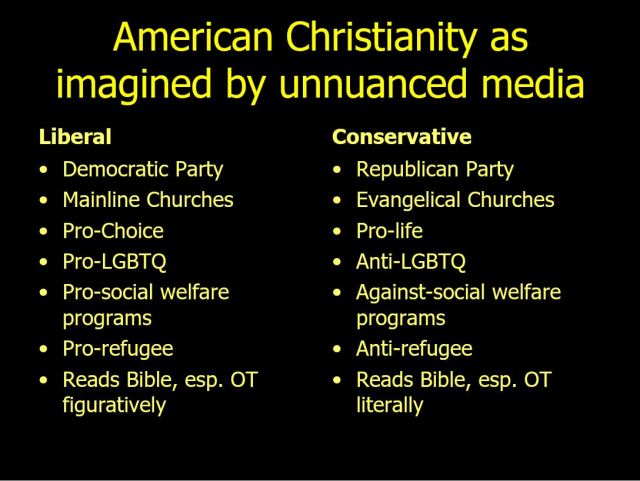
This arrangement like all stereotypes has a certain amount of validity but if you look too closely you’ll immediately see problems. One of the most glaring is that it ignores what is by far the nation’s largest Christian denomination, the Roman Catholic church which is pro-life, pro-refugee, against the Trump wall and has a long and complex tradition of Bible reading and interpretation.

How good can the stereotype be if it doesn’t even hold for the largest denomination in the country?
All of this in some ways makes the point for the article I began with. What is the point of referring to the Bible when the Bible doesn’t seem to produce the kind of agreement we assume it should.
Christian Smith, a sociologist who teaches at Notre Dame makes this point in his book The Bible Made Impossible.
My line of reasoning in this book will run as follows. First, I will argue that most biblicist claims are rendered moot by a more fundamental problem (which few biblicists ever acknowledge) that undermines all the supposed achievements of biblicism: the problem of pervasive interpretive pluralism. Even among presumably well-intentioned readers—including many evangelical biblicists—the Bible, after their very best efforts to understand it, says and teaches very different things about most significant topics. My suggestion is that it becomes beside the point to assert a text to be solely authoritative or inerrant, for instance, when, lo and behold, it gives rise to a host of many divergent teachings on important matters. Authority implies and requires definitive instruction, direction, or guidance. As the nineteenth-century Princeton Seminary theologian Charles Hodge stated, “If the Scriptures be a plain book, and the Spirit performs the functions of a teacher to all the children of God, it follows inevitably that they must agree in all essential matters in their interpretation of the Bible.”[6] But definitive instruction, direction, or guidance is precisely what pervasive interpretive pluralism precludes.
Smith, Christian. Bible Made Impossible, The: Moving from Biblicism to a Truly Evangelical Reading of Scripture (Kindle Locations 108-116). Baker Publishing Group. Kindle Edition.
The Mouth of God doesn’t resolve the problem Continue reading
Posted in On the way to Sunday's sermon
Tagged The Gospel of Matthew, The Sermon on the Mount
1 Comment


