
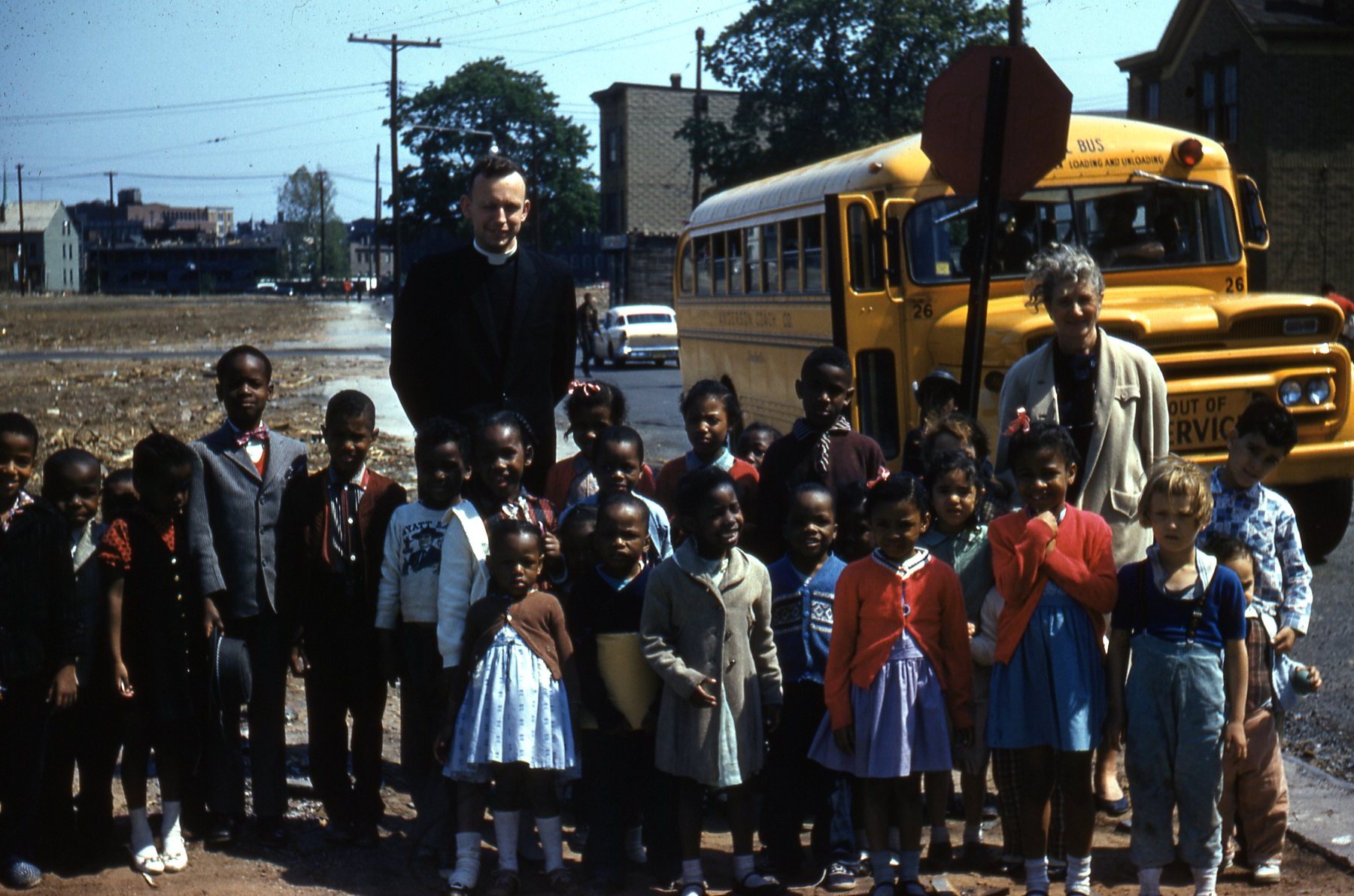
Northside Mission
Guns AND Butter
The Second World War banished the fantasy of isolation for the nation. The US had to commit and sacrifice to bring down Japan and Germany and that mobilization required that the walls of insular religious communities like the CRC must come down as well. Great existential threats have a way of leading us to live outside of our natural matrixes of basic desire. In that way they themselves are a cousin of religion.
Archie’s Big One gave way to another great struggle, the Cold War. The Cold War, unlike the hot one against Germany and Japan did not require the level of blood sacrifice that America offered in the sands of Normandy or small Pacific Islands we had never heard of before. The Cold War was surely an anxious war, fearing the nuclear threat to end civilization, but its two major blood lettings in Korea and Vietnam produced different results than the struggle of the 40s. In the Cold War America could afford BOTH guns and butter. We could afford the self righteousness of the great moral struggle against godless Communism AND the American dream made flesh in suburban living.
It was no accident that both mainline and evangelical versions of Christianity flourished during the Cold War period. The Cold War was a new crusade, not against Islam, and not lead by a church unified in Rome, but a church that while differing on details expressed in denominational fragmentation could shape a consensus around an American image of “the good” found in America’s own story of moral achievement and triumph. Churches, Fundamentalist, Mainline or Immigrant might not be able to agree on doctrines of Election, Infant Baptism or even the Virgin Birth but their consensus around a public morality could be maintained across religious sectarian lines. The same type of consensus that immigrant churches could find in the Bible that Mark Noll highlighted could be achieved and expressed in a broader vision backed by the virtue AND science and promoted by media and embodied in institutions like the Boy Scouts of America. This consensus of public morality would of course come unraveled in the 60s and 70s but that would get ahead of the story.
The CRC’s Distrust of Ease
While on one hand the CRC joined the new American Imperial party in embracing the new suburban good life it, like many others in America, harbored a deep suspicion that new found wealth and pleasures might not be in its best spiritual interest.
The CRC was not alone in this angst about the new post-war comfort. Again, check out George Marsden’s book on the subject but as with many things the CRC would have its own take.
In the post-war the CRC would, like many other churches, begin to loosen her moral scold on “worldly amusements”. Rook would continue to be the card game of choice yet “playing cards” would now be tolerated. Movies would no longer be banned while into the 70s Sabbath observance would continue to be maintained. The CRC like many other religious groups in the nation were sticking their toes in the warm bath of affluence while like the nation finding it could afford both guns (new church buildings, new denominational agencies, new Christian schools, new retirement homes, new health care centers, etc.) and butter (new homes, better education, new luxuries).
The Ripening of Enlightenment Fruit
Thomas Jefferson, while owning and raping his own slaves had of course modified John Locke’s ideas by penning them into the Declaration of Independence. Men were endowed by their creator with inalienable rights. The notes on the American debt to enslaved African involuntary immigrants would once again be called due. The combination of the scourge of Jim Crow and the need for labor in the Industrial North deprived of cheap immigrant labor by the two World Wars launched “The Great Migration”. (Read Isabel Wilkerson’s fine book The Warmth of Other Suns) The African American community organized and lead by her own churches were about to shake and rewrite the moral conversation of America and with it the CRC.
As CRC families were building new suburban homes, building new suburban churches, building new suburban Christian schools others looked back on the neighborhoods they had left and watched them fill up with African Americans leaving the Jim Crow south looking for better jobs and better justice.
CRC members were subject to the same kinds of bigotry and biases as their other white neighbors and there are plenty of horror stories of white flight and racial segregation in our story. There are also, however, many stories of CRC folk who saw the plight of many in the great migration and out of Christian charity wanted to help in the best ways they knew how. Some of these people were heroes I didn’t sufficiently value in my youth, Herb Van Denend, Jacoba Woudenberg, and Angie Vogel. (You can read some of their stories and many others in my father’s book Chains of Grace.)
Instinctive benevolence that first took more colonial forms would be transformed by the broader Civil Rights movement lead by Dr. King and others. This again would be another example, like that of the move from evangelicalism, would be another example of the broader conversations in the North American church and society impacting and even steering CRC developments. The CRC would by rocked by the conflict over Timothy Christian School and establish for itself a standing committee, SCORR, to give racial reconciliation a prominent place in the denominational conversation.
The template established by the race conversation would both in the West and the CRC become a lens through which other disempowered groups would seek liberation and status. The racial reconciliation conversation would vie with the old morality of early cold war and as we are seeing eventually supplant it.
Taxonomy of Our Factional Layers
There is way more I’d love to explore about the relationship between our experience with the Civil Rights movement and the shaping of the new morality but I can’t do that today. My main agenda with this series is to explore the interchange of our cultural, theological layers that underlie the factional coalitions in the CRC today. The shape of the CRC today with an eye to collaboration with the RCA tomorrow is created by these factions and conversations. In these ways we are more like the RCA, and other denominations than we have probably been at any point in our history. At the same time there are ways that the CRC’s history has made us unique.
We are seeing the development of the layers and get hints at how they’ve shaped us.
- James Bratt sketches out the old confessional factions into the 1970s
- The 1950s and 60s sees parts of the CRC begin to assimilate with American evangelicals, no longer finding leadership in her own people but with the evangelical community increasingly looking to the likes of Billy Graham, Robert Schuller and Bill Hybels for the shape of church and piety
- The Civil Rights movement adds a new strain to the song. The public consensus of 1950s white society begins to be challenged and a new public morality begins to emerge.


 Leadingchurch.com