

Dr. Steve Timmermans interviewed by CRC Synod for the position of Executive Director
Dr. Steve Timmermans interviewed by CRC Synod for the position of Executive Director

I couldn’t keep up with all of his points and these notes don’t do it justice. You can probably watch it on the Synod webpage. It was a lovely, heart-felt farewell.

Upsides and downsides on more reliance on above ministry-share support
Upsides
Downsides
Observation

CRC RCA Joint Synod
The CRC-RCA Joint Resolution
Tonight in a joint session of Synod the CRCNA and the RCA passed this resolution.
Therefore, as the General Synod of the Reformed Church in America and the Synod of the Christian Reformed Church in North America, we declare that the principle that guides us, and the intention that motivates us, is to “act together in all matters except those in which deep differences of conviction compel [us] to act separately”; and, further, We jointly instruct the Board of Trustees of the Christian Reformed Church and the General Synod Council of the Reformed Church in America, in looking to the future relationship between our two denominations, to be guided by this principle.
I think to the shock of the officers a joint CRC-RCA pair attempted to amend the statement.
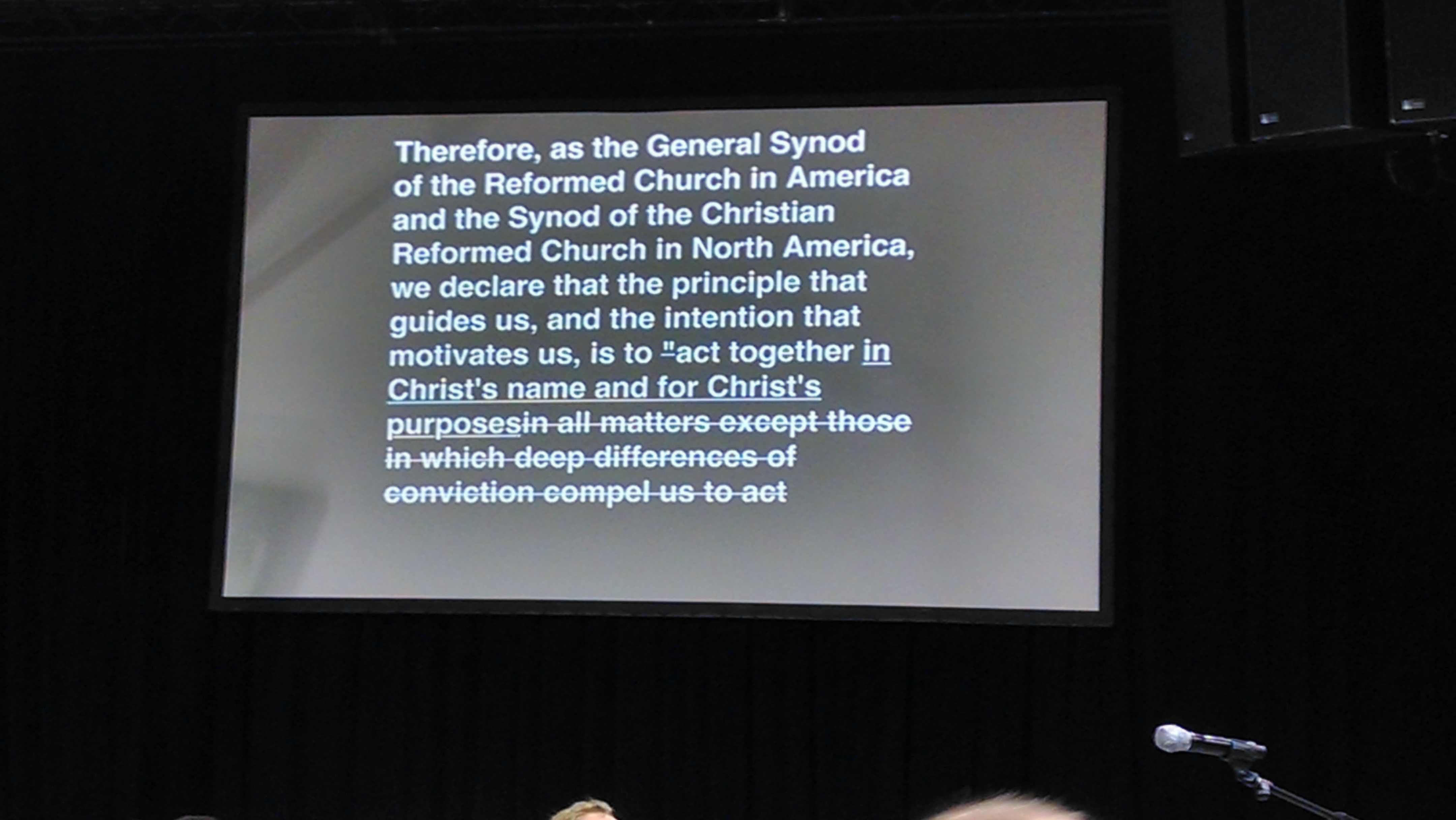
Failed Amendment
The statement in quotes was “The Lund Principle“.
The objection to the quote was that it was feared to give “a way out” of serious collaboration.
This quotation implies the opposite.
The question formulated at Lund inverts the typical denominational point of view. It subtly shifts the burden from a council of churches back to its member denominations to judge for themselves the sufficiency of their “eagerness” to “act together in all matters.” The Lund Principle presses on a council of churches and its denominational membership the contemplation of an entirely different perspective on the interrelationship between them because it calls them to confront the key question of how well they are living out the ecumenical vision of not only being together, but acting together. Does their being together enable them to be acting together?
Still, the difficulty with the Lund Principle lies not so much in the discipline it seeks to impose on both the member denominations and the council of churches to which they belong as it does with the way those party to any serious conversation about it are likely to respond, this is, to recoil instinctually in institutional horror from the uncompromising implications of it. A council of churches would be remiss in its duty if it failed occasionally to remind its member denominations of the Lund Principle, the radical demands it makes on them and the practical application it has for them. If the ecumenical movement can be said to have a conscience, surely the Lund Principle is it.
Table Discussion Continue reading
At Cal State, the nation’s largest university system with nearly 450,000 students on 23 campuses, the chancellor is preparing this summer to withdraw official recognition from evangelical groups that are refusing to pledge not to discriminate on the basis of religion in the selection of their leaders. And at Vanderbilt, more than a dozen groups, most of them evangelical but one of them Catholic, have already lost their official standing over the same issue; one Christian group balked after a university official asked the students to cut the words “personal commitment to Jesus Christ” from their list of qualifications for leadership.

Overture 18 from Classis Wisconsin
While the Banner gets all the sizzle the massive overture from Classis Wisconsin deserves the prize for most ambitious. The overture lays out the teachings not only of the Walhout who wrote one of the scorned Banner articles but also the two Calvin profs who published papers regarding questions of historicity and Genesis. Their published words were laid out in contrast pertinent articles of the confessions.
First let me say that part of me LOVES challenges like this. It is a stand-up, ambitious, “let’s live what we say we believe” type of overture that asks the CRC to put up or shut up. We’re subscribed to these historical words and we are facing these contemporary challenges, let’s put the champions in the ring and see who prevails! Life is too short and precious to always equivocate!
Another part of me just says, “oh no”. A 5 years study committee will spend tens of thousands of dollars in expenses and triple that in uncompensated salary levies for the institutions that these “brightest and best” are already working for. At the end of 5 years they will bring forth a document the size of a book that some will read carefully and fewer will be swayed by it only to have the same theological factions be for or against it based on their commitments to these matters formed prior to Synod 2020 and mostly shaped by sociological factors in their own communities of confidence. Is it worth it?
Those same political forces will be arrayed at this Synod. Some will say “we don’t want to study this because the committee may ask for change” The same fear that motivated last year’s debate on a homosexuality study committee. Another group will think “we need this so that we can stop picking on Calvin profs and these persecuted fellows can be vindicated…” Another group will say “we’ll go through all of this effort and it won’t change a thing. Confessions work best when we pledge allegiance to them and like Victorian children are seen but not heard. The church should focus its energy on evangelism, church growth, pastoral care, and all of the things that make a real difference. These squabbles we will always have with us. They only divide us. We need to make disciples of Jesus…”
The Denomination Question Again Continue reading


